

The best thoracic mobility exercises train two movements your mid-back needs: extension (opening backward) and rotation (turning). Six simple drills, done for about ten minutes on 3 to 4 days a week, cover both. Below you get each exercise step by step, how often to do it, what a good effort feels like and when your mid-back needs a hands-on assessment. If your upper back stays stiff or sore despite regular work, our team in Calgary can assess why and treat it directly.
Your thoracic spine is the part of the spine that sits behind your chest. Each of its twelve vertebrae connects to a rib, which makes this region sturdier and less flexible than your neck or lower back. That stability protects your heart and lungs, but it also means mobility is easily lost when you sit, drive, lift or train in the same positions every day.
When the mid-back does not move well, other areas often pay for it. Researchers writing on thoracic exercise note that thoracic mobility, motor control and strength matter for athletic kinetic chain function and for limiting stress on other spinal regions. In plain terms: if your mid-back will not rotate in a golf swing, a throw, a swim stroke or a rowing pull, your lower back and shoulders find the movement somewhere else.
That is why people who feel tight between the shoulder blades, struggle to reach overhead, or feel their low back grumble during rotation sports often start here. A 2026 systematic review also found that thoracic-focused rehabilitation, including breathing and mobility exercises, may help reduce fear of movement in people with low back pain. Moving the mid-back well can make movement feel less risky, not only look better.
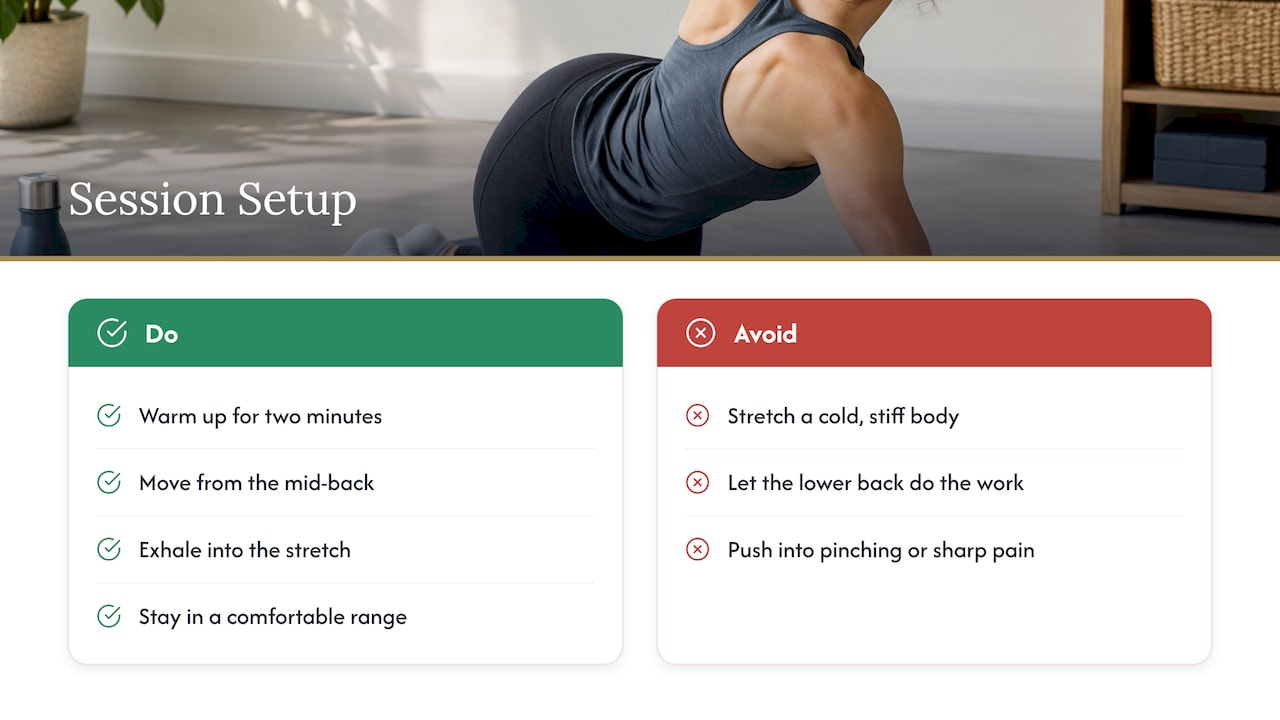
A few basics make every exercise below work better.
Warm up first. Two minutes of walking, arm circles or easy cat-cow gets blood moving. Mobility work is not a stretch for a cold, stiff body.
Move the mid-back, not the lower back. The most common mistake is letting the lumbar spine (lower back) do the work. Several drills use a kneeling heel-sit or similar position for exactly this reason: it fixes the lower back so the motion comes from the mid-back. If you feel the movement in your low back, reduce the range.
Breathe slowly. Exhale as you move into the stretch and let the ribs soften. Strength and conditioning guidance on thoracic mobility suggests longer breathing phases within the drills, which helps the rib cage move.
Stay in comfortable range. You should feel a stretch or gentle pull, never a pinch or sharp pain.
Do the exercises in this order. Total time is about ten minutes.
Lie on your back with a foam roller placed across your mid-back, just below the shoulder blades. Support your head with your hands and keep your hips on the floor. Exhale and gently lean back over the roller, letting your upper back open, then return to neutral. Move the roller up or down a hand’s width every few repetitions. Do 8 to 10 slow reps.
Where it goes wrong: flaring the ribs and arching the lower back. Keep your ribs down and your chin tucked slightly.
Lie on your side with your knees bent to about 90 degrees and stacked, arms straight out in front with palms together. Keep your knees together and the bottom arm still. Lift the top arm and rotate it up and back, following your hand with your eyes, as far as is comfortable. Hold for a slow breath, then return. Do 8 reps per side. This is one of the three simple exercises many clinics use, so we will not add more to it: the point is a slow turn without the knees drifting apart.
Where it goes wrong: letting the top knee roll back. If your knees separate, the movement is coming from the hips and lower back.
Start on all fours with hands under shoulders and knees under hips. Slide one hand under your opposite armpit, palm up, as the shoulder and ear come toward the floor. This rotation exercise promotes thoracic mobility when your hand reaches under the opposite armpit. Pause, then return and reach that arm up toward the ceiling for a full turn. Do 6 to 8 reps per side.
Where it goes wrong: sitting back toward the heels and losing the position. Keep hips over knees.
Sit back on your heels with one hand behind your head and the other on the floor in front of you. Rotate the elbow of the hand behind your head up toward the ceiling, keeping your hips down on your heels. Then bring it back and across. Do 8 reps per side.
In a 2024 study, quadruped and standing rotation exercises produced equivalent improvements in thoracic range of motion over two weeks. That is useful for planning: if kneeling bothers your knees, you can do rotation standing and expect a similar result.
Stand with your back against a wall, feet a short step out, ribs down. Place your forearms on the wall in a goalpost shape. Slide your arms up while keeping your ribs, head and lower back in contact. Stop where the contact starts to break. Do 8 to 10 slow reps.
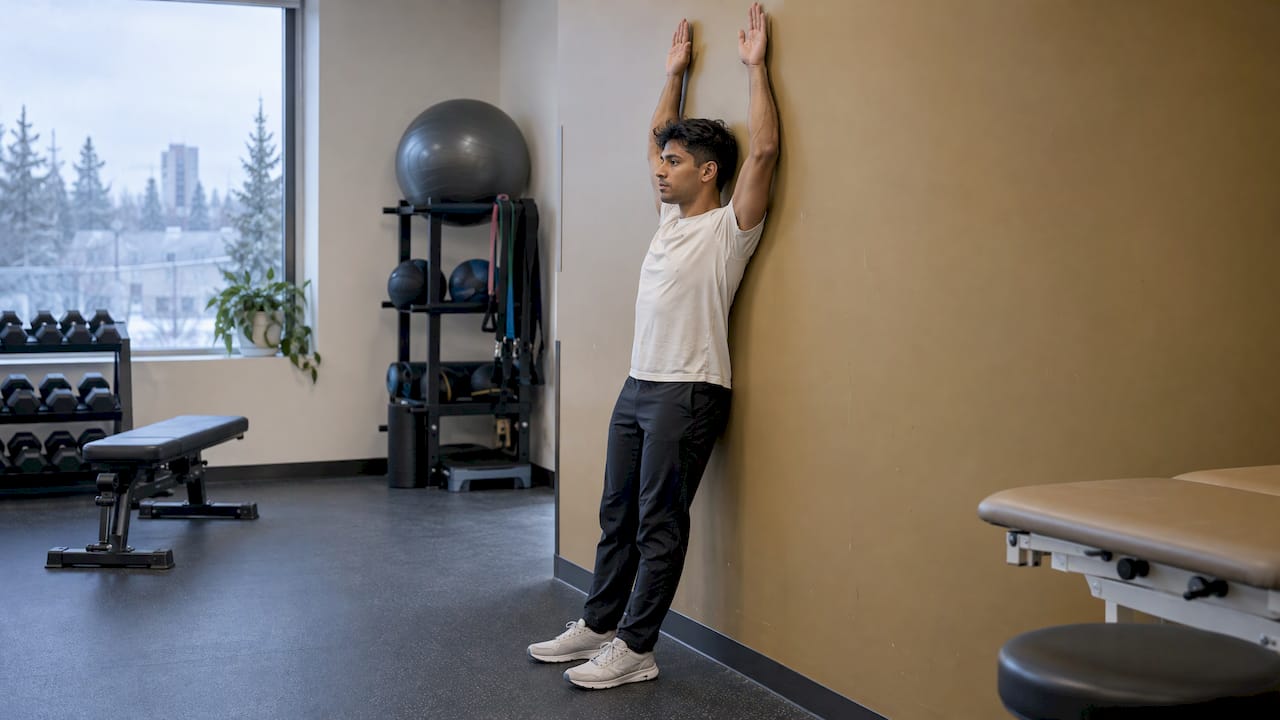
Where it goes wrong: the lower back arches off the wall to fake extra reach. This drill relies on unimpaired upper limb function, so if shoulder pain limits it, shorten the range. Our rotator cuff rehab guide covers shoulder-specific work.
Hold a broomstick across your upper back, arms hooked over it. Stand tall, hinge slightly forward from the hips, and rotate your chest left and right while your hips face forward. Do 10 turns each way. This is also a quick drill to repeat before a workout or game.
A standard recovery guideline is to do exercises 3 to 4 times a week with at least one rest day in between. That is a good start for most people with a stiff or sore mid-back.
If you train, you can use shorter versions as movement preparation. Conditioning professionals suggest that a thoracic routine can include dynamic exercises in movement preparation and warm-ups before and after performance training, up to twice daily. Here is how that can look in a week:
| Day | What to do | Time |
|---|---|---|
| Monday | Full six-exercise routine | 10 minutes |
| Tuesday | Rest or two drills in your warm-up | 2 to 3 minutes |
| Wednesday | Full routine | 10 minutes |
| Thursday | Rest or open book and thread the needle | 3 minutes |
| Friday | Full routine | 10 minutes |
| Weekend | Standing rotation before activity | 2 minutes |
Build up gradually. Start with one round and add reps or a second round over two weeks. Slow, controlled movement matters more than going deeper.
Desk workers. Do foam roller extension and wall slides twice during the workday if you can, and finish with thread the needle at home.
Rotation athletes (golf, hockey, tennis, baseball, rowing). Put the heel-sit rotation and standing rotation in your warm-up. Researchers note that precision training needs to consider posture, age and sport-specific needs, so a hockey player’s emphasis will differ from a cyclist’s.
Lifters. Overhead pressing and back squats need thoracic extension. Open book and wall slides before training help you reach positions without the lower back taking over.
Rounded posture. If your upper back is visibly rounded, extension work is your priority, alongside strengthening. Our kyphosis exercise plan shows a progression for that.
Some soreness is normal. Guidance for recovery exercises says that mild discomfort after exercise is expected, but it should ease within two hours and should not make your overall symptoms worse. If it lasts longer, reduce the range, reps or frequency.
Stop and book an assessment if you notice:
Sudden chest pain, trouble breathing, fever with back pain, or loss of bladder or bowel control needs urgent care: call 911 or go to an emergency department. Do not wait for an appointment.
Self-guided mobility work is a good first step, but it cannot tell you why a segment is stiff. A rib that is restricted, a muscle that is gripping, a nerve that is irritated or a joint that is guarded each calls for a different approach. If you have done the routine for two to three weeks and your range has not changed, or the same area keeps flaring, that pattern deserves a proper look.
At Shephard Health, our practice focuses on diagnosing and treating musculoskeletal conditions, and our plans begin with a biomechanical assessment. If you are not sure what to expect, our guide to your first chiropractic visit walks through it.
We see mid-back stiffness as a movement problem more often than a single-spot problem. The thoracic spine connects the neck, shoulders and lower back, so when it stops contributing, the neighbours compensate. That is why we start with a biomechanical assessment before we recommend any exercise.
Exercises are valuable, and we want you doing them. But they work best when they are matched to what we find: which segments are stiff, which muscles are overworking and how you move in your sport or job. Our team treats musculoskeletal conditions with individualized, evidence-based plans and non-invasive tools such as Active Release Technique, Graston Technique, shockwave therapy, laser therapy and spinal decompression, alongside chiropractic care and physical rehabilitation.
For athletes and active people, that combination of hands-on treatment and a focused home routine is how we aim to restore function and prevent the problem coming back.
Deane
If your upper back keeps tightening up, we can assess it and build a plan around your goals. Our chiropractic care and physical rehabilitation in Calgary include same-day appointments and direct insurance billing where applicable. Depending on what the assessment shows, your plan can include Active Release Technique, Graston Technique or massage therapy for soft tissue that limits your movement.

To book, visit shephardhealth.com. You will leave with a clear plan and exercises that suit your body, not a generic list.
Start with foam roller extension for backward movement, and open book and thread the needle for rotation. Add a heel-sit rotation to keep the lower back still and a wall slide to link the mid-back with the shoulders. Together they cover the main motions in about ten minutes.
A practical start is 3 to 4 times a week with at least one rest day. Athletes can add short drills to warm-ups. Build up gradually and keep the movement slow and controlled.
Either works. A 2024 study found that quadruped and standing rotation gave equivalent improvements in thoracic range of motion. Choose the position that is comfortable for your knees and shoulders and that you will actually repeat.
Mild soreness is common. It should ease within two hours and not worsen your overall symptoms. If pain is sharp, spreads into your arms or does not settle, stop and book an assessment.
Book an assessment if two to three weeks of regular exercises have not improved your range, if the pain keeps returning, or if it followed an injury or accident. Our team in Calgary offers same-day appointments, so you do not have to wait.
Same Day Appointments Available
We Direct Bill!