

Kinesio tape can ease back pain in the short term and help you move more comfortably during rehab, but it works best as a support tool, not a fix on its own. If you’re layering it onto physical therapy or a targeted home exercise routine, you’re in the group most likely to notice a benefit. If you’re hoping it will resolve a structural problem by itself, the research doesn’t back that up.
Multiple randomized controlled trials and at least one meta-analysis point to real, measurable short-term pain and disability reductions when kinesio taping is added to standard care. At Shephardhealth, we treat it the same way: a useful adjunct within a broader clinical plan, not a replacement for assessment and rehab.
Tape not enough, or the pain keeps coming back? Start with a $67 new patient visit
A chiropractor assesses the injury, treats it, and tells you when taping fits. See kinesio taping in Calgary. Book online.
Kinesio tape provides real but modest short-term pain and disability relief, and works best when combined with physical therapy rather than used alone.
| Point | Details |
|---|---|
| Short-term benefit is real | Meta-analysis of 676 patients found KT plus PT reduced pain (SMD 0.73) and disability (SMD 1.01) versus PT alone. |
| Use low tension | Roughly 10 to 25 percent stretch through the tape’s middle appears most effective for pain relief; avoid maximal tension. |
| Not a standalone fix | Evidence quality is rated low overall; treat KT as an adjunct to exercise and rehab, not a replacement. |
| Watch for red flags | Fever, worsening leg symptoms, or bowel/bladder changes call for prompt medical evaluation, not more tape. |
| See a clinician for complex cases | Neurological symptoms, prior spinal surgery, or unclear diagnosis warrant professional assessment before self-taping. |
Working through a rehab plan and want to know if kinesio taping fits your situation? A first visit assessment at Shephardhealth can determine whether taping, combined with treatments like Active Release Technique or targeted chiropractic care, makes sense for your specific pain pattern.
The clearest evidence comes from a systematic review and meta-analysis of 12 randomized controlled trials involving 676 patients with chronic low back pain. Adding kinesio taping to physical therapy produced a standardized mean difference of 0.73 for pain and 1.01 for disability compared with physical therapy alone. In plain terms, that’s a moderate to large improvement, roughly on par with effects seen from some manual therapy interventions. The catch: the review authors rated the overall quality of evidence as low, citing high heterogeneity between trials and meaningful risk of bias.

Individual trials tell a more textured story. One randomized controlled trial of 108 women with chronic low back pain found that kinesio taping, with or without added tension, reduced pain by day 3, and taping applied with tension improved disability scores at both 3 and 10 days compared to a control group. A separate trial that targeted taping placement based on individual skin and fascia mobility found pain and disability improvements at 4 weeks, with benefits in the taped group sustained out to 6 months. Even outside chronic pain settings, a study of patients with acute musculoskeletal injuries in an emergency department found lower 48-hour pain scores and reduced need for pain medication among those taped, with low back pain patients showing a statistically significant response.
Why don’t these numbers always line up cleanly? Trials use different outcome measures, ranging from the Visual Analog Scale to the Oswestry Disability Index and the Roland-Morris Disability Questionnaire, and follow patients anywhere from 24 hours to 6 months. That inconsistency makes pooling results difficult and explains much of the heterogeneity reviewers flag.
The headline effect: SMD 0.73 for pain, SMD 1.01 for disability, when KT is added to physical therapy, based on pooled data from 676 patients.
A widely cited media synthesis of the evidence sums up where experts land: kinesiology tape can offer immediate and short-term relief, but effects are inconsistent enough that it should be treated as an adjunct, never a standalone therapy.
Nobody fully agrees on the exact mechanism, but a few explanations show up repeatedly in the research. Kinesio tape’s gentle lift on the skin may improve local circulation and lymphatic flow, easing pressure on underlying pain receptors. It also delivers ongoing sensory and proprioceptive input, essentially giving your brain a steady stream of feedback about where your low back is in space, which can dial down the perception of pain during movement. Fascial modulation and expectation effects likely play a role too.
What that means practically: you’re more likely to feel an immediate difference in movement tolerance than a lasting structural change. Someone recovering from a disc-related flare who couldn’t tolerate a bird dog or bridge exercise might find that taped support lets them complete a session with less guarding. That’s the real value, not healing tissue, but making rehab work possible on a day it otherwise wouldn’t be.
Good results start before the tape ever touches your skin. Clean the area with soap and water, dry it completely, and shave excess hair so the adhesive can bond properly. If you’ve never used kinesio tape before, apply a small test strip on your forearm and wait 24 hours to check for redness, itching, or a rash before taping your back.
I-strip for the paraspinals
Y-strip for broader support
X or star pattern for a focal, localized pain point
Pro Tip: A lab study on tape tension found that low tension, around 25 percent stretch, significantly reduced pressure-evoked muscle pain, while higher tension and no tension at all showed no meaningful benefit. When in doubt, stretch less, not more.
Before you go about your day, check adhesion by moving through a few normal motions, bending, twisting, reaching. If a corner is already lifting, press it down or trim it before it catches on clothing.
Kinesio tape is low-risk for most people, but it’s not appropriate for everyone. Skip taping entirely if you have an open wound, active skin infection, a known adhesive allergy, or suspected deep vein thrombosis in the area. If your back pain follows a recent injury with suspected fracture or spinal instability, taping is not a substitute for imaging and medical evaluation.
Certain symptoms need prompt attention rather than a home remedy. Seek urgent care if you notice fever alongside back pain, progressively worsening or spreading leg pain, numbness in the saddle region, or new bowel or bladder changes. These can signal nerve compression or infection that taping cannot address.
Pro Tip: Do a 24-hour patch test on your forearm before your first full application. If you develop a reaction later, take a photo, note how long the tape was on, and bring both to your next appointment with a clinician so they can identify the cause.
Most kinesio tape products are designed to stay on for several days, typically 3 to 5 days, though some waterproof versions are rated up to a week depending on your skin and activity level. Replace it sooner if it starts lifting at the edges or if your skin feels irritated underneath.
Taping shines as a bridge, not a destination. Clinicians commonly use it to reduce pain enough that a patient can complete an activation exercise they’d otherwise avoid, to reinforce posture awareness during motor control drills, or to support confidence during a graded return to activity. The meta-analysis of 12 trials found that KT combined with physical therapy consistently outperformed physical therapy alone on short-term pain and disability, though the authors caution that study quality overall was low.
A patient who can’t tolerate a bridge exercise due to pain might tape up, complete two weeks of graded activation work, and progress to full-range strengthening once confidence and tolerance improve.
Self-application makes sense for simple mechanical back pain: no radiating leg symptoms, no red flags, and you can physically reach the area well enough to apply tape evenly.
Book a clinician instead if you notice neurological symptoms like numbness or weakness, if your pain doesn’t follow a clear mechanical pattern, if you’ve had prior spinal surgery, or if you’re simply not sure what’s causing your pain. A targeted, clinician-guided taping approach based on individual fascia mobility produced sustained improvements at 6 months in one trial, something generic self-application is less likely to replicate. Shephardhealth’s kinesio taping service pairs assessment with technique, so tape placement targets your actual movement restrictions rather than a generic pattern.
Wider strips, generally 2 to 3 inches, give better coverage across the broad muscles of the lower back than narrower tape made for smaller joints. Cotton-based tapes breathe well for daily wear, while synthetic and waterproof versions hold up better through workouts and showers. Look for hypoallergenic, latex-free adhesive if you have sensitive skin.
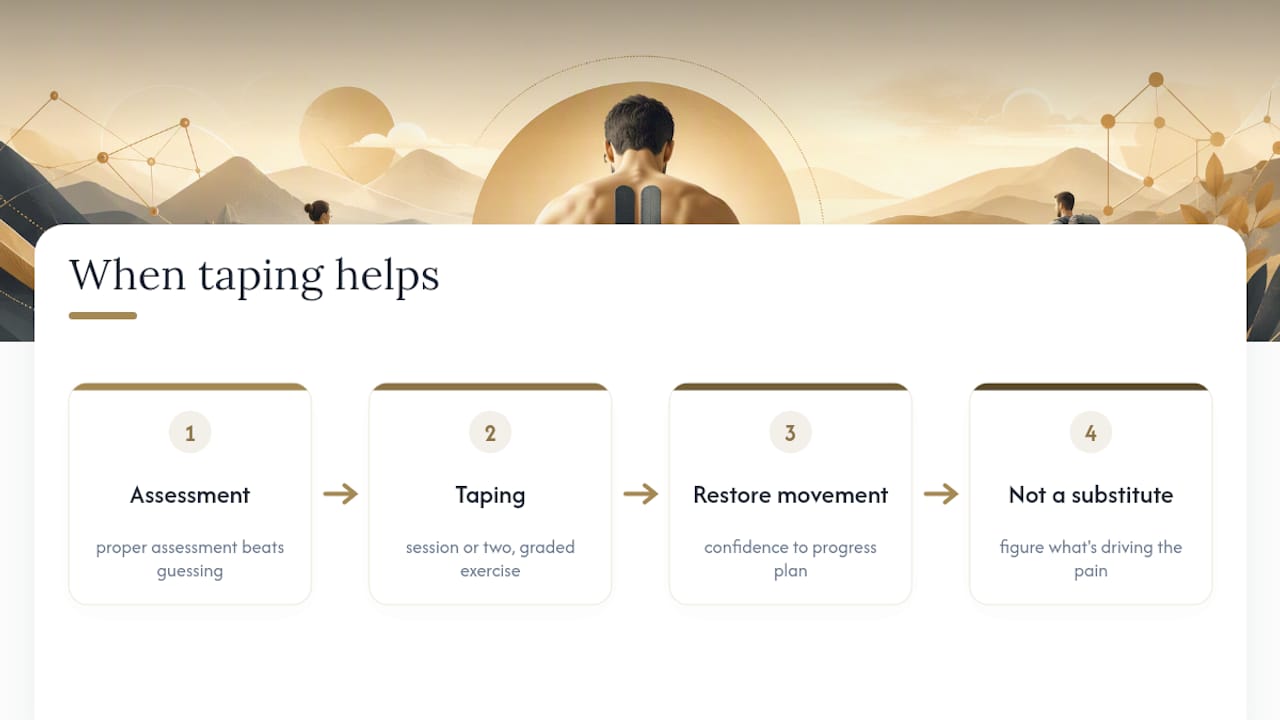
In practice, kinesio tape earns its place when it gets a patient moving again, not when it’s used as a crutch. A common scenario: someone with an acute flare who’s avoiding basic hip hinge and core activation work out of fear. Taping the lower back for a session or two, paired with graded exercise, often restores enough confidence to progress the plan within a couple of weeks.
That’s the honest use case. It’s a bridge to rehab, not a substitute for figuring out what’s driving the pain in the first place. If you’re unsure whether taping fits your situation, a proper assessment beats guessing.
Does kinesio tape actually reduce back pain, or is it mostly placebo?
Both are likely at play. Meta-analytic data shows a measurable pain and disability benefit when kinesio tape is added to physical therapy, but researchers acknowledge that expectation and sensory feedback effects contribute alongside any physical mechanism.
How is KT Tape different from RockTape or generic kinesiology tape?
The tape itself, whether it’s KT Tape, RockTape, or a generic version, uses similar elastic cotton or synthetic material and adhesive. Differences come down to stretch percentage, adhesive strength, and price rather than a fundamentally different mechanism of action.
How long does it take to feel relief after applying kinesio tape?
Some people notice a sensory difference within minutes of application. Clinical trials have shown measurable pain reduction by day 3, with disability improvements documented at both 3 and 10 days in controlled studies.
Can I wear kinesio tape every day for chronic back pain?
Most people can wear it for several consecutive days per application, replacing it as needed, but continuous long-term daily use without reassessing your rehab plan isn’t well studied. Talk to a clinician if you’re relying on it beyond a few weeks with no functional progress.
Is kinesio taping technique for back pain something I can learn on my own?
Basic patterns like the I-strip and Y-strip are learnable at home with a patch test and careful attention to tension. More targeted taping based on your specific movement restrictions benefits from a clinician’s assessment, particularly for persistent or recurring pain.
Same Day Appointments Available
We Direct Bill!