

Most groin strains are strains of the adductor muscles on the inner thigh, and most mild to moderate ones settle with protected movement, a short period of relative rest and a progressive strengthening program. The part that decides how well you recover is rarely the ice pack. It is how carefully you reload the muscle over the following weeks. This guide walks you through the first 48 hours, the rehab stages, realistic timelines, and the signs that your pain is not a simple strain.
Your groin is where several muscles meet the pelvis. A groin strain is an injury to one or more of them, most often the adductors that pull your leg toward the midline. A review of exercise and load management for adductor injuries describes hip-adductor injuries as the most common cause of acute and long-standing groin pain in athletes.
Typical triggers are sprinting, sudden changes of direction, kicking, skating and wide lunging movements. That is why hockey, soccer and running sports in Calgary see so many of them. But a stretch on a slippery step or a heavy day of yard work can do it too.
Clinicians grade strains by severity. Cleveland Clinic’s overview lists three grades: mild (grade 1), moderate (grade 2) and severe (grade 3). Symptoms it describes include sharp pain, trouble moving the leg or hip, weakness, bruising, swelling and spasms.
You cannot reliably tell at home, and the words “pulled” and “torn” overlap, since any strain involves some fibre damage. These clues point toward a more serious injury:
If any of these apply, book an assessment rather than waiting. A hands-on exam and strength testing tell a clinician far more than an image of your symptoms can.
Early care has changed from the old “rest completely” advice. Berkshire Healthcare’s physiotherapy advice uses the P.O.L.I.C.E. approach for the first 48 to 72 hours: Protection, Optimal Loading, Ice, Compression and Elevation. The Optimal Loading part matters: start light, comfortable movement once it feels okay, instead of immobilizing the leg.
Protect. Stop the activity that caused the injury and avoid anything that provokes sharp pain: sprinting, kicking, wide steps. If walking causes a limp, load-management guidance notes you may need crutches temporarily until walking is normal and painless.
Load gently. Short, flat, pain-free walks are generally fine. Pain that rises during or after activity is your signal that the load was too high, so scale back.
Ice. A Leeds Community Healthcare guide suggests 15 to 20 minutes every 2 to 3 hours in the first 48 hours, with a thin cloth between the pack and your skin to avoid ice burns. MyHealth Alberta is the provincial health resource for home-care instructions if you want an Alberta-specific reference.
Compress and elevate. A snug compression wrap or shorts can reduce swelling and make the area feel supported. It should never cause tingling, numbness or colour change in the leg.
Two habits slow people down. The first is aggressive stretching. It feels productive, but in the acute phase it can delay healing and increase pain. The second is masking the pain so you can keep training. Products such as DMSO are used this way, but a Government of Canada fact sheet says there is very little scientifically valid research showing it helps any medical condition. If pain is quiet only because it is covered up, you may load damaged tissue and turn a two-week problem into a chronic one.
Passive treatments can ease symptoms, but strength and load tolerance are what protect you from a repeat injury. Research on adductor rehab stresses that progression should depend on what you can do without pain, not on how many days have passed. The prospective cohort study on criteria-based rehabilitation of acute adductor injuries was built on that principle.
The stages below are a general framework, not a prescription. Your assessed grade, your sport and your pain levels decide where you start.
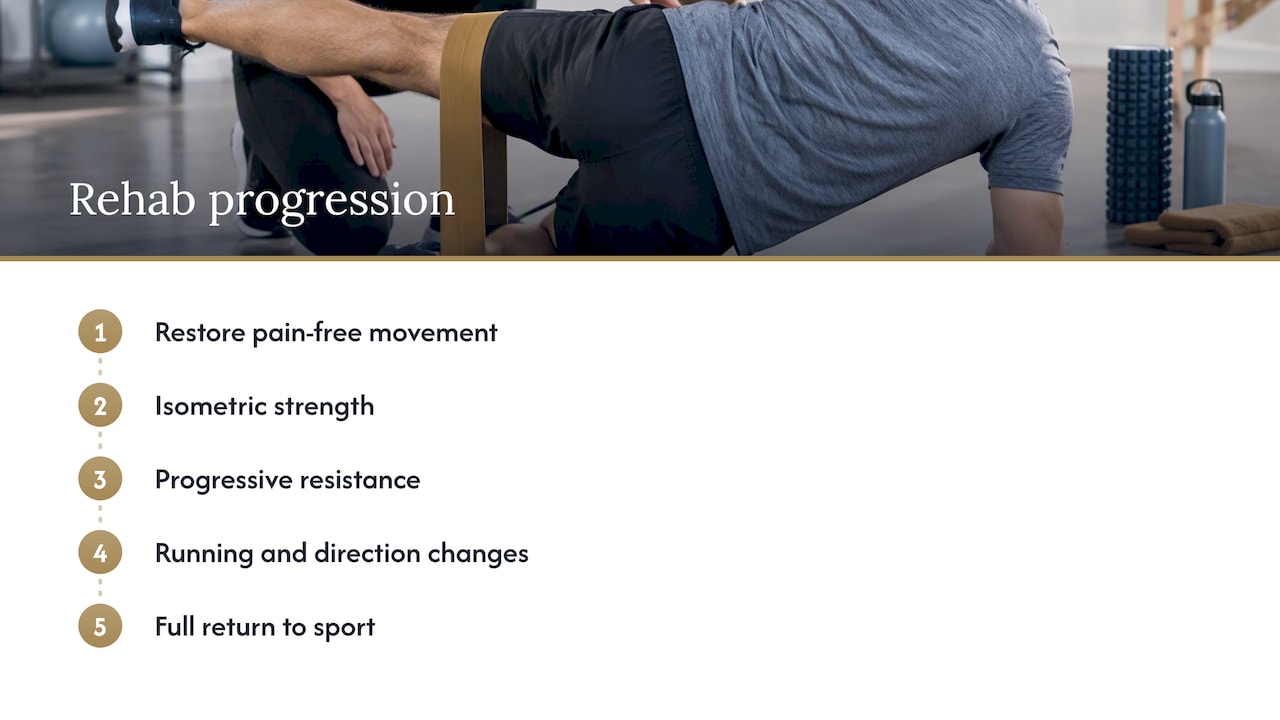
Once the first 48 hours are past and symptoms are improving, begin gentle range-of-motion work, such as small, comfortable leg swings or easy knee-to-chest movements, staying well inside the pain-free range. The aim is to prevent stiffness and muscle wasting without irritating the tissue. Move on when everyday walking and stairs are pain-free.
Isometric exercises tense the muscle without changing its length. A common example is squeezing a pillow or soft ball between your knees while lying down, building from light effort to firmer effort over several days. Keep the pain at a low level and settled by the next morning. If it climbs, you went too hard.
Now the muscle is loaded through movement: side-lying hip adduction, resisted adduction with a band or cable, and then split squats and side-step patterns as they become comfortable. Increase load or repetitions one variable at a time. The clinical concepts review says forcing tissue to adapt too quickly is the most common cause of recurrence.
Build from straight-line jogging to faster runs, then to curved paths and cutting. Each step should be pain-free the day after. A structured warm-up before every session helps here, and a pre-round golf warm-up routine shows how a short, repeatable sequence can prepare the hips for rotation and load, whatever your sport.
Return to practice with your team or group first, then to competition. This is where timing matters most. In that cohort, athletes who returned to full training before they were pain-free had a reinjury rate of 21%, against 5% for those who waited.
Many clinicians use a pain scale during rehab, for example allowing mild discomfort during an exercise as long as it settles quickly afterward. Our patellar tendinopathy rehab guide uses a similar 3 out of 10 rule, and the same logic applies to the adductors. Ask your clinician what threshold fits your injury.
It depends on severity. In a prospective cohort study of male athletes following criteria-based rehab, those with grade 0 to 2 injuries were clinically pain-free after a median of 13 days and back in full team training at 18 days. Those with grade 3 injuries took far longer: about 55 days to be pain-free and 78 days to full training.
| Severity | Typical pain-free point | Typical return to full training |
|---|---|---|
| Grade 0 to 2 (mild to moderate) | About 13 days | About 18 days |
| Grade 3 (severe or complete tear) | About 55 days | About 78 days |
These figures come from athletes in a supervised program, so treat them as a guide. If you are sedentary, older, or returning to a demanding sport, your own timeline may differ. For a wider look at how strains and sprains differ in recovery, see our article on muscle strain versus sprain, and for the broader recovery model, our guide to PEACE and LOVE soft tissue recovery.
Yes, as long as it is pain-free. Walking keeps the area gently active, which supports healing. If it causes a limp or sharp pain, shorten the distance, slow down, or use crutches briefly. Avoid sprinting, cutting and sudden high-speed efforts in the early phase.
The groin is a crossroads of muscles, tendons, joints, the abdominal wall and organs. A true strain has a logical link to a specific load or sporting event. MyHealth Alberta advises getting care when groin pain comes with other symptoms, and clinical pathways flag the following:
These need prompt medical assessment. In an emergency, or if pain is severe and sudden, go to urgent care or the emergency department.
Persistent pain is another signal. A UK regional hip pathway document describes adductor-related groin pain that eases with warm-up, improves with gentle activity, then returns as stress increases. If your pain has not settled after several weeks of consistent, appropriate rehab, ask for a deeper assessment. Chronic groin pain can involve the hip, the pubic area or the abdominal wall, and may call for a multidisciplinary approach. A clinical review in American Family Physician lists the many possible causes, from hip joint problems to hernias and genitourinary conditions.
We treat musculoskeletal injuries every week, and the groin strains that frustrate people most follow a pattern. The first few days go well, pain fades, and the person returns to full activity because it feels fine at walking pace. Then the first sprint or hard side step brings it back. That is not bad luck. It is a plan that was based on the calendar instead of on function.
Our approach starts with a comprehensive biomechanical assessment: where exactly the pain is, which movements reproduce it, how the hip, pelvis and trunk are moving, and how strong the adductors are compared with the other side. From that we build an individual plan around your sport and your goals. We use hands-on soft tissue work and technology to ease symptoms and restore movement, but we treat them as support for progressive loading, not as replacements for it.
We also think honesty matters more than reassurance. If your history does not fit a strain, we will say so and point you toward the right assessment.
— Deane
You do not need a clinic for every mild strain. But an assessment is worth it if you cannot walk normally, if pain is not improving after a week or so, if you play a sport that demands sprinting or cutting, or if this is a repeat injury.
At Shephard Health in Calgary, a visit begins with a thorough assessment and an individual plan. Depending on what we find, treatment may include Active Release Technique for soft tissue restrictions, Graston Technique (see also our piece on Graston for athletes), laser therapy, shockwave therapy or massage therapy, alongside a rehabilitation program. We offer same-day appointments and direct insurance billing where applicable. If you are not sure where to start, read what to expect on your first visit or go straight to our physical rehabilitation and booking page.
If you have rehabbed other strains, the logic will feel familiar. Our guides to calf strain rehab and ankle sprain rehab follow the same stage-by-stage thinking.
Once you are back, a few habits lower the odds of a repeat:
There is no shortcut, but you can avoid delays. Protect the muscle for the first 48 to 72 hours, keep gentle pain-free movement going, and progress your strengthening only when each stage is pain-free. Rushing back is the most reliable way to lose time, since returning before you are pain-free raised reinjury rates in the research above.
Not aggressively in the early phase. Stretching a freshly strained muscle can increase pain and delay healing. Gentle, pain-free range-of-motion work is appropriate once the first 48 hours have passed and symptoms are improving, and your clinician can tell you when more stretching makes sense.
No, not at full intensity. Pain during sport means the load is too high for the healing tissue, and masking it with products or tape to push through risks a bigger injury. Return to training in steps, and to competition only after you are pain-free in full practice.
See a clinician if you cannot walk normally, if pain has not improved after a week or so, or if it keeps returning. Seek prompt medical care for fever, swelling, urinary or bowel symptoms, a groin bulge, or pain with no clear injury behind it.
Same Day Appointments Available
We Direct Bill!