

Pain around the shoulder blade that burns, aches or tingles is very often a nerve irritated somewhere else, usually in the neck, rather than a problem in the shoulder blade itself. Most cases ease with time, movement and the right hands-on care. A few signs mean you should be seen quickly, and we list them below. Here is how to tell what you may be dealing with, what you can try at home, and how a clinician narrows down the cause.
The shoulder blade (scapula) has no nerve of its own that commonly “pinches” in the way people imagine. What readers usually describe is pain that sits under or beside the blade, sometimes with a trail of symptoms elsewhere. The American Academy of Orthopaedic Surgeons (AAOS) notes that cervical radiculopathy pain usually starts at the neck and travels down the arm, and that it is usually burning or sharp.
Other symptoms the same source lists include tingling or pins and needles in the fingers or hand, weakness in the arm, shoulder or hand muscles, and numbness or reduced sensation. The Cleveland Clinic adds that a pinched nerve can feel like tingling, burning, prickling, numbness, or a sharp or dull ache, with weakness more likely when the nerve is moderately to severely compressed.
In practice, people tell us the pain feels like one or more of these:
A deep, burning line along the inner edge of the blade that is hard to reach or rub out. A sharp catch when turning the head or reaching overhead. Pins and needles in the forearm or fingers that come and go. A heavy, tired arm after desk work or a long drive. Pain that is worse at night or first thing in the morning.
No single feeling proves the cause. That is why the next section matters.
The most common source is in the neck. According to AAOS, cervical radiculopathy most often arises from age-related degenerative changes in the spine, or from an injury that causes a herniated or bulging disk. Bone spurs can also narrow the small openings where the nerve roots leave the spine and press on the nerve.
From there, daily habits often decide how much it bothers you. Long hours with the head forward, one-sided loading such as carrying a heavy bag, repetitive overhead work or sport, and awkward sleeping positions can all keep an already sensitive nerve irritated. We see this often in desk workers, hockey and baseball players, climbers, swimmers, and parents lifting kids all day.
The nerve can also be irritated further along its path, where it passes through tight muscle or the space between the collarbone and first rib. Tight muscles do not create a nerve problem out of nothing, but they can add to it, which is one reason soft tissue treatment is part of many plans.
Shoulder-blade pain has many possible sources, and a good assessment sorts through them before treatment starts. AAOS lists shoulder conditions, including thoracic outlet syndrome and suprascapular nerve compression, as conditions that can mimic cervical radiculopathy.
Other common look-alikes are a strained muscle between the blade and spine, rotator cuff irritation, a stiff or irritated rib joint, and an upper-back joint that has locked up. A frozen shoulder is another possibility when movement is lost in many directions; if that sounds like you, our stage-by-stage frozen shoulder guide explains what to expect.
One simple test clinicians use is the shoulder abduction sign. A 2024 academic review explains that raising the arm overhead often relieves cervical radiculopathy pain by easing traction on the nerve root, whereas it may worsen pain that comes from the shoulder itself. If resting your hand on top of your head makes the arm symptoms calmer, the neck becomes a stronger suspect. Do not treat this as a diagnosis; it is one clue among many.
Rotator cuff trouble often shows up at night. One study cited in a 2020 review reported night pain in about 89% of patients with rotator cuff tears. Night pain alone does not separate the two conditions, which is why a hands-on exam, strength and sensation testing, and your history all count. If your pain leans toward the shoulder, our guides on shoulder impingement exercises and rotator cuff rehab may fit better.
Canadian chiropractic guidance on thoracic and chest wall pain stresses that localized tenderness does not rule out serious pathology, so a safety screen should come before any assumption about the tissue at fault. Ontario’s clinical handbook for shoulder disorders likewise says assessment of non-traumatic shoulder pain should screen for serious pathology, such as unexplained swelling, whole-body symptoms or suspected cancer. We do this at every first visit, and we refer you on when something falls outside what chiropractic and rehabilitation care should manage.
Most nerve irritation is not an emergency. Some signs are. Alberta Health Services advises getting medical care right away for new or worsening numbness, tingling, weakness or pain in the arm, and calling 911 if you cannot move an arm or leg. The same guidance says to seek immediate care for loss of bladder or bowel control.
If your shoulder-blade pain follows a fall, car accident or sports collision, or comes with fever, unexplained weight loss, chest pain or shortness of breath, see a physician or go to an emergency department before booking anything with us. Chest pain on the left side with arm or blade pain should always be treated as urgent until a doctor says otherwise.
Alberta Health Services states that for many people, symptoms from a pinched nerve in the neck improve over time, and that early care usually includes medicines for pain and swelling, with physiotherapy and special exercises that may help. Ask a pharmacist or physician which pain medicine suits you; we do not advise on medication.
Here is a sensible first-week approach.
Canadian clinical guidance for shoulder problems recommends avoiding the positions and activities that aggravate symptoms. For a nerve near the blade, that often means raising your screen to eye level, taking your hands off the keyboard every 30 minutes, switching the shoulder you carry a bag on, and pausing overhead work when the arm starts to tingle.
Supporting the forearm during daily tasks can reduce strain on the shoulder. Parents who are feeding a baby will find practical ideas in this article on breastfeeding after a shoulder injury, where forearm support takes load off the painful side.
Ontario’s handbook recommends home exercises as a first-line non-surgical approach, alongside heat or cold for temporary relief of symptoms. Use whichever feels better on the sore area, for short periods, with a cloth between the pack and your skin. Our article on ice versus heat covers the timing in more detail, though it was written for back pain.
The same Canadian guideline recommends several short exercise sessions rather than a few long ones. Think two to three minutes, a few times a day. MyHealth Alberta publishes a simple set of shoulder-blade exercises, such as shoulder rolls and shoulder-blade squeezes, that suit this approach. Our guide to cervical radiculopathy exercises goes further when the neck is the likely source.
The rule we give patients: movement should leave you the same or better within a few minutes. Stop an exercise if it sends pain, tingling or numbness further down the arm, or if symptoms are worse the next morning. Come back to it at a lower range or fewer repetitions, or have us check it.
Night is when many people feel this most. We have no research source to offer on a single best sleeping position, and the right one differs by person, so treat these as practical starting points rather than rules. Try a pillow that keeps your neck level with your spine rather than bent to either side. If you sleep on your back, a small pillow under the painful forearm can reduce pull on the shoulder. If you sleep on your side, lie on the less painful side and hug a pillow so the upper arm is supported. Avoid lying on the painful arm or sleeping with your head propped high on several pillows. If raising your arm gives relief, as in the abduction sign above, resting the hand on a pillow beside your head may feel better. Change anything that makes the morning worse.
The goal is to settle the irritated nerve, restore normal movement in the neck, upper back and shoulder, and keep it from returning. The Canadian Physiotherapy Association describes physiotherapy in Canada as using manual therapy, personalized therapeutic exercise and functional training to improve mobility and prevent decline. Our approach combines those ideas with chiropractic care.
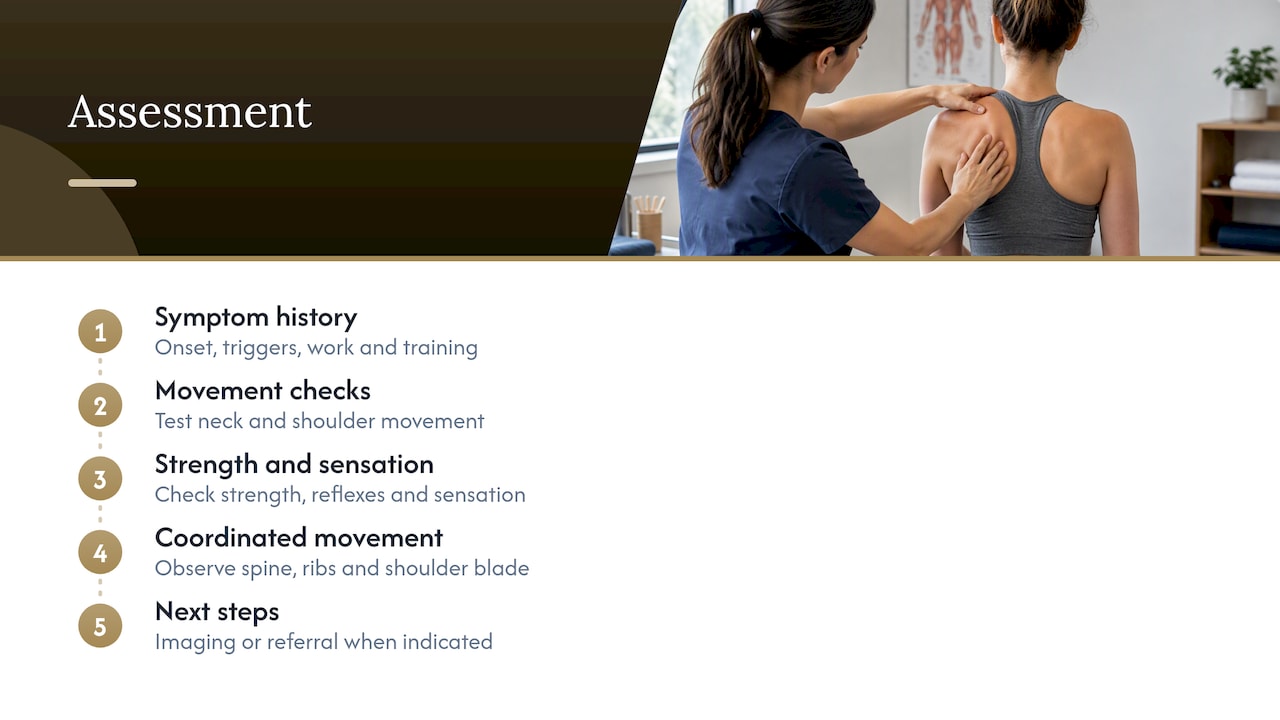
Your first visit starts with your story: when it began, what eases or worsens it, your work and training. Then we test neck and shoulder movement, strength, reflexes and sensation, and look at how your spine, ribs and shoulder blade move together. If you have not been before, what to expect on your first chiropractic visit walks through it. We may recommend imaging or a physician referral when the findings call for it.
Which of these we use depends on what the assessment finds. They are not a package everyone receives.
Chiropractic adjustments and mobilization can restore motion to stiff joints in the neck and upper back; our chiropractic care page describes the approach, and the review of chiropractic adjustment safety explains what to ask any provider. For tight, overworked tissue around the blade, Active Release Technique and Graston Technique work on muscle and fascia, and massage therapy can calm guarded muscles; see also how massage can relieve neck pain. Where a disc in the neck is involved, spinal decompression may be considered. Laser therapy and shockwave therapy are options we may add for stubborn soft tissue pain. Nerve flossing, a gentle movement technique, is part of our rehabilitation program for nerve-related symptoms.
Our article on pinched nerve neck treatment covers the neck-focused steps in more depth.
Pain relief is only half the plan. Strengthening the muscles that hold the blade and neck in good position, improving how you set up your desk or training, and a gradual return to sport are what stop the cycle. If tight trigger points are part of the picture, our four-week trigger point plan shows how that stage can look.
If your pain sits between the shoulder blades or wraps around the ribs, the nerve involved may come from the mid-back (thoracic) spine instead of the neck. This is much less common and harder to pin down. A 2023 review notes that assessment involves a history and exam for pain or sensory change along a nerve’s skin path, weakness, and uneven abdominal reflexes, with MRI used to identify nerve-root compression. It adds that physiotherapy may help, but the evidence is of low certainty and treatment depends on the cause.
We share that honestly. If your pattern suggests a mid-back source, we will assess carefully, treat what is appropriate, and coordinate with your physician for imaging when needed.
People arrive convinced they have “a pinched nerve in the shoulder blade” and have often stretched the blade for weeks with little change. Our experience is that the blade is usually where the pain is felt, not where the problem starts. When we look at the neck, upper back, ribs and shoulder together, the picture usually becomes clearer and the plan more targeted.
We also believe the best plan is individual. An athlete who needs to return to training has different goals from a parent with a sleepless baby or an office worker with a long commute. We assess the biomechanics first, explain what we find in plain language, and make your goals the measure of progress. We keep passive care short and build in exercise so you leave with something you can do yourself.
— Deane
If your shoulder-blade pain has lasted more than a few days, keeps returning, or comes with tingling or weakness, a proper assessment saves time. We offer same-day appointments, direct billing to insurance where applicable, and a multidisciplinary team in Calgary. See our services or book through our site to start with a full assessment of your neck, upper back and shoulder. Check with your insurer about your coverage for chiropractic and rehabilitation visits.
For many people the symptoms improve over time, as Alberta Health Services notes. Reduce the positions and tasks that aggravate it, do short gentle exercise sessions, and use heat or cold for comfort. If it is not clearly improving within a couple of weeks, or you have arm weakness, have it assessed.
Rotator cuff problems, muscle strain, thoracic outlet syndrome, suprascapular nerve compression, frozen shoulder and stiff upper-back joints can all feel similar. Heart and lung problems can also refer pain to the shoulder and blade. That is why a hands-on exam and screening for serious causes come first.
Gentle movement within a comfortable range is usually fine, but aggressive stretching can irritate a sensitive nerve. Stop if the tingling spreads down the arm or the pain worsens afterward. A clinician can show you which movements suit your pattern.
Often, when the cause is joint stiffness or muscle tension around the neck and upper back that is irritating the nerve. Care should begin with an assessment and a safety screen, and you should be referred on if the findings do not fit chiropractic care.
Call 911 if you cannot move an arm or leg, and seek immediate care for loss of bladder or bowel control or for new or worsening arm weakness or numbness. Chest pain, shortness of breath or pain after significant trauma also needs urgent medical attention.
Same Day Appointments Available
We Direct Bill!