

Lumbar radiculopathy is irritation of a nerve root in your lower back, and it usually responds best to conservative care first: staying active, education, guided exercise, hands-on therapy and, if needed, short-term medication. Surgery is reserved for cases where those measures fail or where there are emergency signs. Below, we walk you through how the problem is diagnosed, what each treatment option does, which symptoms mean you should not wait, and how we approach it at our Calgary clinic.
A nerve root exits your spine through a small opening on each side. When a herniated disc, a narrowed opening or inflamed tissue presses on or irritates that root, the nerve sends signals along its whole path. That is why the problem you feel in your leg often starts in your back. Lumbar radiculopathy involves exactly this nerve root irritation with radiating leg pain, and a disc herniation is a common cause, according to Government of Canada clinical guidance.
The same guidance lists numbness or tingling in the affected leg and pain that increases with coughing, sneezing or straining as common symptoms. Which part of the leg is affected depends on which nerve root is involved, so a careful clinician maps where you feel symptoms rather than guessing.
Diagnosis is based primarily on a detailed history and physical examination, including straight leg-raise testing. The government guidance also notes that imaging is generally not needed in the first 4 weeks unless red flags for serious disease are present. That surprises many people who expect an MRI at the first visit.
There is a good reason for it. Research on chronic spine pain shows that imaging findings correlate poorly with symptoms. Many people have disc bulges on scans and no pain, and a scan alone cannot tell you what is driving yours. Your history, your neurological findings (strength, reflexes, sensation) and how you respond to movement tell us far more.
Your assessment should always include a neurological screen. If you are seeing a provider who does not check strength, reflexes or sensation in your legs, ask why.
The most common mistake we see is bed rest. It feels protective, but current Canadian guidance points the other way. Ontario Health’s quality standard for low back pain says initial care includes education and ongoing support for self-management, and that people are encouraged to continue daily activities, modifying them as needed to maintain or improve mobility and function. The same standard recommends physical activity, education and self-management for adults with acute low back pain.
Note that this standard addresses acute low back pain in general, and radiculopathy is a more specific problem. The principle still applies: movement, adjusted to your symptoms, beats prolonged rest for most people.
In practice, that means:
Understanding the pain also matters. Canada’s pain task force describes a biopsychosocial model of care for chronic pain, aiming to optimize pain management, improve function and reduce suffering. Sleep, stress and fear of movement all change how intensely you feel nerve pain, so good care addresses them alongside your spine.
Exercise is the backbone of recovery, but the right exercise depends on your pattern. A 2024 academic review of conservative treatment for lumbar disc herniation reports that extension exercises may improve low back pain, while flexion movements may aggravate pain related to disc herniation.
That is a general tendency, not a rule for every body. Some people with spinal stenosis feel better bending forward, and some with a disc problem feel worse arching back. This is why we test your response to repeated movements in the clinic before prescribing anything.
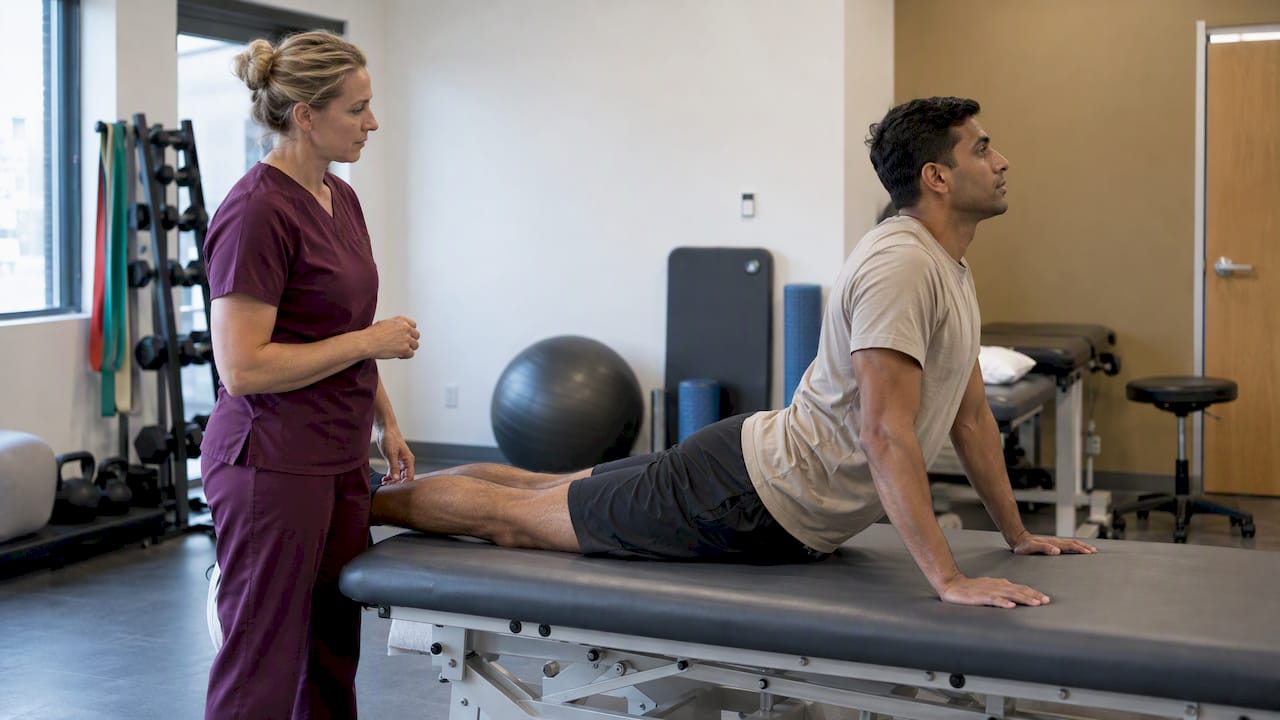
Watch where your leg symptoms go while you move. If pain travels closer to your back (centralizes) as you repeat an exercise, that is usually a good sign. If symptoms spread farther down your leg or numbness increases, ease off and have a clinician reassess your program. Mild, short-lived back soreness after exercise is typical. New weakness is not.
Once the acute irritation settles, rehabilitation widens to include hip and core strength, hip mobility, and graded return to the activities you care about, whether that is lifting, running or sitting through a workday. Our physical rehabilitation team builds this progression around your goals. If you want a deeper look at how active rehab pairs with traction-based care, see our guide to spinal decompression for sciatica and why active rehab matters.
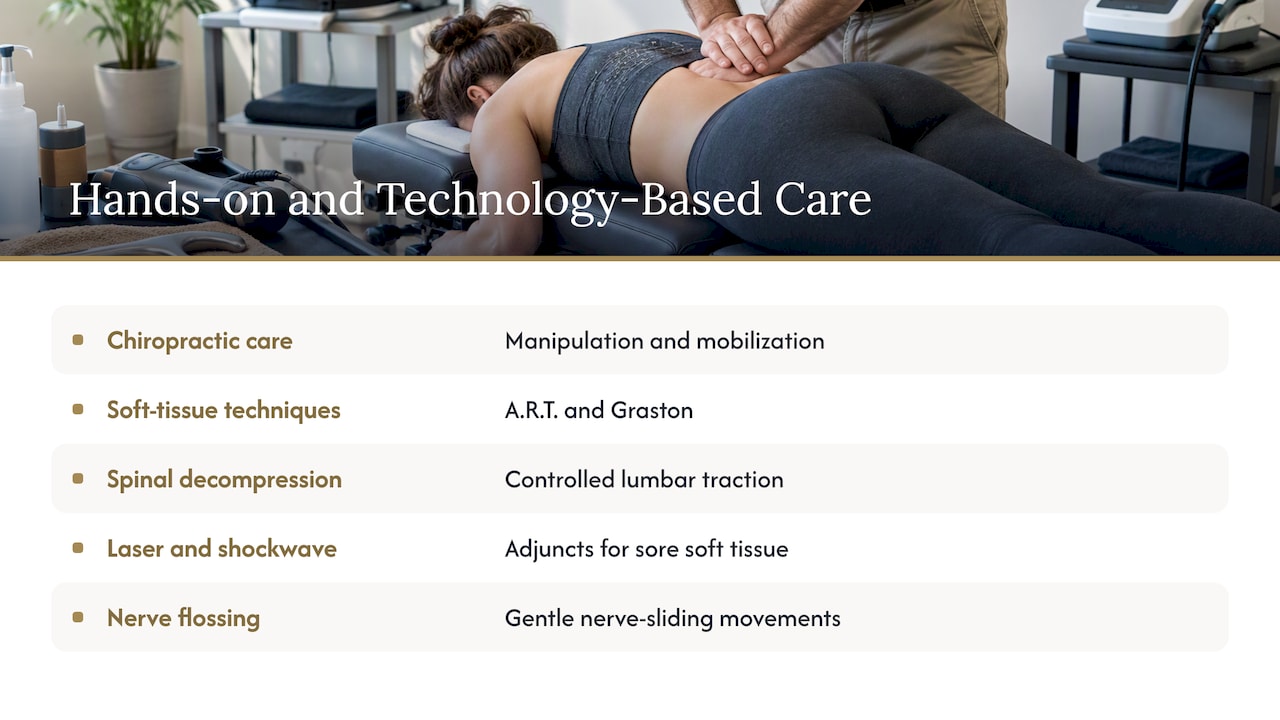
Manual therapy is not a cure for a herniated disc, and we do not present it as one. What it can do is reduce the muscular guarding, joint stiffness and soft tissue restrictions that often accompany nerve irritation, so that you can move and exercise more comfortably. Here is how each tool fits.
Chiropractic care. Spinal manipulation and mobilization address stiff or restricted segments. For radiculopathy, technique selection matters: we choose gentler, lower-force options when your nerve is highly irritated. You can read how we approach this in chiropractic care for sciatica, and our chiropractic adjustment safety review explains what to ask any provider.
Active Release Technique (A.R.T.) and Graston Technique. These soft tissue methods target tight muscles and scarred or restricted tissue in the hips, glutes and lower back that may contribute to nerve irritation or limit movement. See Active Release Technique for sciatica or the pages on A.R.T. and Graston Technique.
Spinal decompression. A non-invasive table-based approach that applies controlled traction to the lumbar spine. It is used by some clinicians for disc-related leg pain, and we pair it with active rehabilitation rather than relying on it alone. Details are on our spinal decompression page.
Laser and shockwave therapy. These are adjuncts we use on sore soft tissue around the problem area. They support comfort and tissue recovery and are not a replacement for movement-based rehab. Learn more about laser therapy and shockwave therapy.
Nerve flossing. Gentle sliding movements designed to help an irritated nerve move more freely through the tissues around it. We introduce them once your symptoms are calm enough to tolerate them.
Not every one of these is right for you, and more is not better. A good plan uses the fewest tools that move you forward, and changes if you do not improve.
If activity and education are not enough, medication can bridge you through the worst of it. Ontario Health’s standard says people whose acute low back pain does not improve with those measures are offered information on the risks and benefits of nonopioid analgesics to improve mobility and function. It names NSAIDs as the first choice for pharmacological therapy when non-drug measures are insufficient, and says opioids should not be used routinely.
NSAIDs carry stomach, kidney and cardiovascular risks for some people, so check with your physician or pharmacist before starting them, particularly if you take blood thinners, have kidney disease or a history of ulcers. Medication decisions belong to your doctor, and we coordinate with them when your care calls for it.
For persistent nerve-type pain, your physician may discuss other prescription options. Those fall outside what we prescribe, and the decision depends on your health history.
Epidural steroid injections and nerve root injections are commonly offered when leg pain is severe and not settling. The evidence is more nuanced than their popularity suggests. A 2025 BMJ guideline on interventional procedures for chronic spine pain strongly recommends against epidural injections of local anesthetic, steroids or their combination for chronic radicular pain. The guideline defines chronic as lasting 3 months or longer, with pain on at least half of the days in the previous 6 months, and it does not apply to acute spine pain.
So timing matters. If you are in the first weeks of a severe episode, an injection may be a reasonable conversation with your physician. If you have had leg pain for many months, the guideline suggests that injections are not the answer, and a well-structured rehabilitation program is worth the effort first. If you are considering an injection, ask the physician what outcome you can realistically expect and how long it should last.
If you do have one, the technique used to guide the needle does not appear to change the broader pathway much. One comparison study found no significant difference in surgical referrals between patients treated with CT-guided and fluoroscopically guided transforaminal epidural steroid injections.
Most lumbar radiculopathy improves without surgery, though recovery varies from person to person and can take weeks to months. Surgery is typically considered when conservative management fails or in emergencies such as cauda equina syndrome, per the Government of Canada guidance. The same source names persistent neurological deficits, failure of conservative treatment and your own goals as factors that shape the timing and need for an operation.
We do not perform surgery. If your symptoms and exam point that way, we refer you promptly and continue to support your rehabilitation before and after. Choosing surgery after a real trial of conservative care is a sound decision, not a failure of that care.
Some symptoms need urgent medical attention, meaning the emergency department rather than a booked visit. According to Government of Canada guidance, these include:
These can signal cauda equina syndrome or another serious compression, and delay can cause lasting harm. Go to an emergency department or call 911 if any of them appear. Also see a physician promptly if you have leg pain after significant trauma, unexplained weight loss, fever, or a history of cancer.
There is no honest single timeline. Many people notice meaningful change within the first several weeks of active care, while some need longer, and a minority have symptoms that linger. What we can say is how we judge progress: your leg symptoms should be moving closer to your back, your walking and sitting tolerance should be increasing, and your strength should be holding or improving. If those markers are not changing after a reasonable trial, we change the plan or refer you on.
What tends to predict a smoother recovery is not a particular device. It is staying active, getting an accurate assessment early, and following a progressive program you actually understand.
For longer-lasting pain, the whole-person side matters too. Sleep, stress and recovery habits all shape how your nervous system handles pain, and some readers explore natural pain relief methods alongside their clinical care. Discuss anything you add with your treating clinician.
We see lumbar radiculopathy every week, in desk workers, tradespeople, runners and parents who lifted a toddler the wrong way. The fear is usually the same: Is something seriously wrong with my spine? Most often the answer is that a nerve is irritated and your body has a good capacity to settle it, with the right guidance.
Our approach starts with a comprehensive biomechanical assessment, because two people with identical diagnoses can need very different plans. We combine chiropractic care, active rehabilitation and, where they fit, tools like decompression, A.R.T., laser and shockwave, and we measure whether each one is helping. We would rather change a plan than keep repeating one that is not working.
We also believe patients deserve straight talk. Manual therapy and technology can ease symptoms and open a window for rehab, but strengthening and movement habits are what hold results. And when your presentation is outside our scope, referring you is part of good care.
— Deane
If leg pain, numbness or tingling has lasted more than a few days, an early assessment helps you avoid weeks of guesswork. Our team offers same-day appointments, direct insurance billing where applicable, and a treatment plan built around your goals, whether that is getting back to sport or simply sitting through a meeting comfortably. Start with our page on sciatica treatment in Calgary, or learn about our chiropractic care.

Not sure what a first visit involves? Read what to expect on your first chiropractic visit, or book through Shephard Health.
Often it improves without surgery over several weeks to a few months, though some people have longer-lasting symptoms. Staying active and following a guided program usually supports that recovery better than rest alone. If you have weakness, worsening numbness or no improvement, get reassessed.
Usually not. Government of Canada guidance says imaging is generally not needed in the first 4 weeks unless red flags for serious disease are present. Your history and physical exam guide the first stage of care, and your clinician can order imaging sooner if the findings call for it.
For most people, gentle walking is helpful, and Ontario Health encourages continuing daily activities with modifications as needed. If walking sends pain farther down your leg or increases numbness, shorten the distance and have your program reviewed.
It depends on your pattern. Research suggests extension-based exercises may help many people with disc-related back pain, while flexion movements may aggravate it, but this is not universal. A clinician should test your response before prescribing a routine.
Surgery is typically considered when conservative care has failed or in emergencies such as cauda equina syndrome. Persistent neurological deficits and your own goals also influence the decision. Discuss it with your physician or a spine surgeon if you are not improving.
Same Day Appointments Available
We Direct Bill!