

Most costochondritis settles with a short period of activity changes, heat or ice, and pain medicine used as directed. Gentle movement and, when needed, hands-on rehabilitation help while the irritated rib joints calm down. The condition is inflammation where your ribs meet the breastbone or cartilage, and it hurts enough to feel alarming. That is why the first step is always to make sure the pain is not coming from your heart or lungs. This guide walks you through that check, the home care that is supported by health authorities, the exercises that fit, how long recovery usually takes, and when a chiropractor or rehabilitation team can help.
Costochondritis is a diagnosis of exclusion in practice: the chest wall is tender, and nothing more dangerous explains the pain. Harvard Health Publishing notes that costochondritis is generally not dangerous unless infection is present, but that it is vital to rule out cardiac or other serious triggers.
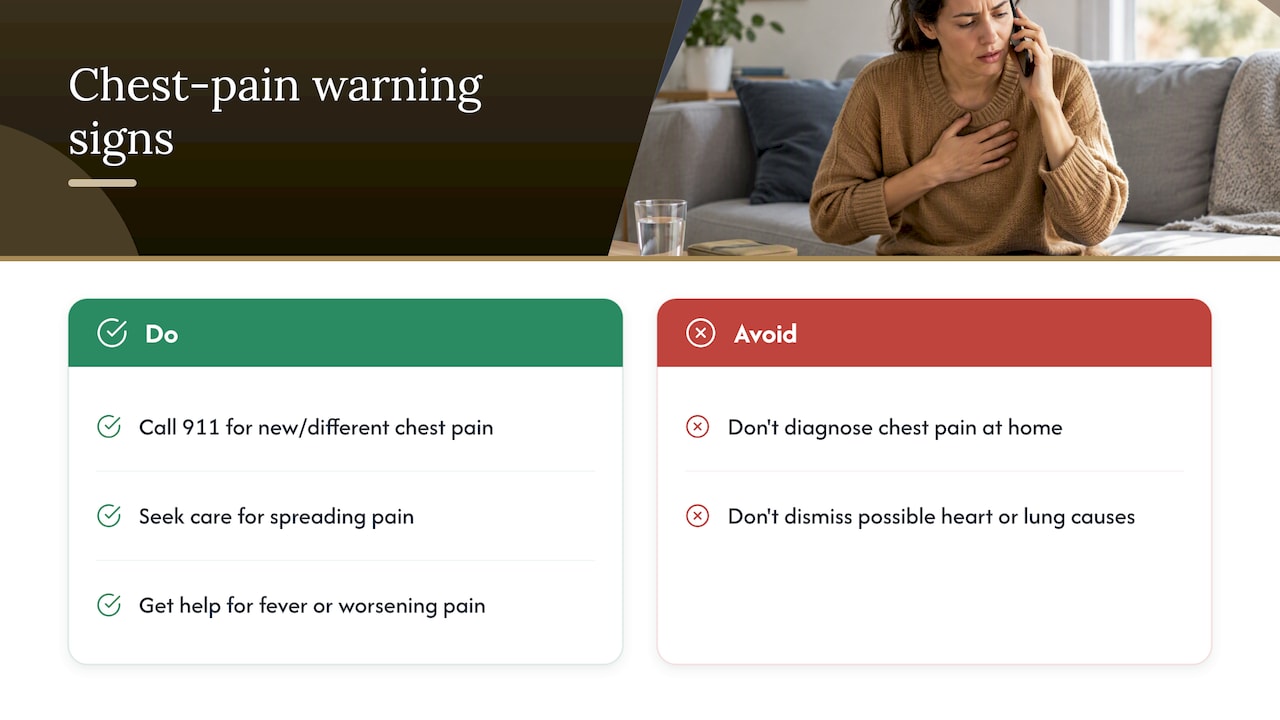
Alberta Health Services is direct about what needs urgent attention. Call 911 for new or different chest pain or pressure, including pain that spreads to the neck, jaw, shoulders or arms. The same page lists shortness of breath, nausea, vomiting, dizziness and sweating as reasons for urgent assessment. A fever, a cough, or pain that worsens despite treatment also calls for prompt medical help.
The Cleveland Clinic also advises emergency care for heart attack symptoms such as shortness of breath, nausea, palpitations or lightheadedness. If you are unsure which category your pain falls into, treat it as the serious one until a physician says otherwise. You do not need to feel embarrassed about a false alarm.
A useful clue, not a diagnosis: costochondritis pain is often sharp or aching and tender when you press on the affected joint. Only a clinician who examines you can tell you whether that applies to your pain.
Your ribs attach to your breastbone through cartilage. Where the rib meets that cartilage, a small joint can become irritated and inflamed. The result is chest wall pain that can worsen with deep breaths, coughing, twisting or pushing and pulling.
NHS inform describes the condition as self-limiting, meaning it can get better on its own over time. It also notes that strenuous exercise or repetitive movements that stress the chest can make it worse. In active people, that often means bench pressing, rowing, swimming, heavy lifting at work, or a long stretch of hard coughing.
The core of treatment is simple, and it is the same across most official guidance. Alberta Health Services advises taking pain medicines as directed, using heat, and avoiding activities that strain the chest. Ask your pharmacist or doctor which medicine suits you, especially if you take other medications or have stomach, kidney or heart conditions.
AHS suggests a warm compress or a heating pad on low, or alternating heat and ice. When you use ice, apply a cold pack for 10 to 20 minutes at a time with a thin cloth between it and your skin. Some people find heat loosens the area, while others prefer cold for sharp flare-ups. Try both and keep what helps. If you want a deeper look at how to sequence them, our guide on ice and heat for back pain explains the same logic for another region.
The StatPearls review lists topical medications and oral NSAIDs as the standard of care, and says that refractory cases may be referred for further treatment. The Mayo Clinic notes that TENS nerve stimulation may reduce pain by masking pain signals. It also says that in rare cases where conservative measures fail, a provider may inject a corticosteroid and numbing medicine into the joint. Those steps belong with your physician, not at home.
One point surprises many people. AHS says not to use tape, an elastic bandage, a rib belt or anything else that restricts chest wall motion. Skip wrapping your ribs for comfort, even if it feels supportive. Restricting your breathing movement can slow the recovery you are trying to speed up.
The honest answer is a range. AHS says chest wall pain from costochondritis may last from days to weeks. MedlinePlus reports that it most often goes away on its own in a few days or weeks, though it can take up to a few months. The Cleveland Clinic similarly describes a few days to a few weeks, and rarely several months.
Two timing rules are worth keeping in mind:
Can it come and go? Yes. The Cleveland Clinic says costochondritis can return even after it has fully healed. Recurrence is a good reason to look at the pattern behind it: your lifting technique, posture at a desk, how your shoulders and upper back move, and how quickly you ramped up training.
Resting completely sounds sensible, but too little movement can slow things down. NHS inform advises keeping activity-related pain within 0 to 5 out of 10 and explains that too much rest can slow recovery. Use that scale as your daily guardrail: if an activity pushes you above 5, scale it back.
The Canadian Chiropractic Guidelines for thoracic and chest wall pain take the same view. They recommend short-term modification of clearly aggravating tasks, such as lifting, pushing, pulling or direct pressure, while comfortable movement and daily activity continue. A graded return can use pacing, planned breaks and gradual exposure.
For non-specific musculoskeletal chest wall pain, the same guidelines list thoracic and shoulder-girdle mobility, trunk and upper-body strength or endurance, aerobic activity, breathing-related movement and task-specific practice as options. The type, amount and progression should match your presentation, goals, capacity and how irritable the area is. In plain terms: the right exercise is the one that your pain allows today, repeated in small, steady doses.
The Mayo Clinic says treatment may include physical therapy with gentle chest muscle stretching. Health New Zealand describes a specific pectoral stretch you can try:
If the stretch sharpens your pain, back off the angle. Stretching an irritated area has its own limits, and our partner-style reading on when it is safe to stretch an injury covers how to tell discomfort from harm.
The Canadian guideline’s exercise recommendations apply to non-specific musculoskeletal chest wall presentations. They do not establish effectiveness for thoracic radiculopathy, a nerve-root problem that can also cause band-like chest or rib pain. When the cause is uncertain, an individualized assessment is the right move rather than guessing at exercises.
Physiotherapy has a recognized role. Health New Zealand’s public guidance describes physiotherapy for costochondritis as potentially including posture advice, gentle exercises and hands-on treatment to mobilise stiff back areas. That reflects something we see often: the painful rib joint is sometimes the part that complains, while a stiff mid-back or tight shoulder muscles keep loading it.
The Canadian Chiropractic Guidelines advise basing care on the working clinical presentation, safety, goals and how you respond. That is a sensible standard for any provider, and it is how we approach rib and chest wall pain at Shephard Health in Calgary.
Once your pain has been medically cleared, hands-on care may include:
No single technique is a guaranteed cure for costochondritis, and the condition usually settles with time. Treatment is about easing symptoms, restoring comfortable movement, and lowering the odds of the pain returning.
We see costochondritis most often in people who train hard, work at a desk, or have just had a bad cough. The pattern behind the pain matters more to us than the label. A rib joint that flares repeatedly usually sits in a chain: a stiff upper back, rounded shoulders, a tight chest, or a training load that jumped too quickly.
That is why we start with an assessment and ask what you do all week, not only where it hurts. We also want you to hear this plainly: chest pain is never something to diagnose from home. If there is any doubt about your heart or lungs, we send you to a physician or emergency department first, and we are glad to see you afterward.
Once serious causes are ruled out, we favour a calm, staged approach. We keep you moving within comfortable limits, treat the tissues and joints that are stiff, and teach you what to do between visits. We would rather you feel in control of your recovery than dependent on us for it.
— Deane
If your chest pain has been checked by a physician and you are left with rib or chest wall pain that is not settling, or that keeps coming back, we can help. At Shephard Health we offer same-day appointments, direct insurance billing where applicable, and a team that treats athletes, active adults and families. Tools such as laser therapy and shockwave therapy may be considered alongside manual care when they suit your presentation. Read about our rib pain and costochondritis care in Calgary, see what to expect at a first chiropractic visit, or browse our services to find the right starting point.
Here is a practical way to put the guidance together. It is general, so adapt it with your clinician.
Setbacks are normal. A flare after an ambitious workout does not mean you have failed, only that your next step should be smaller.
Most cases improve within days to weeks, and some take up to a few months, according to Alberta Health Services and MedlinePlus. If your pain has not improved after 5 to 7 days, contact your doctor or 811. Persistent or worsening pain deserves a fresh assessment.
Yes. The Cleveland Clinic notes that it can return even after fully healing. Reviewing your training load, posture and upper back mobility can help you reduce repeat flare-ups.
Avoid activities that clearly strain your chest, and do not wrap your ribs with tape, an elastic bandage or a rib belt, because AHS warns against restricting chest wall movement. Do not push through pain above about 5 out of 10, and do not assume new chest pain is costochondritis without a medical check.
Once a physician has ruled out serious causes, chiropractic and rehabilitation care can address stiff spinal segments, tight muscles and movement habits that load the rib joints. Guidelines advise basing care on your presentation, safety, goals and response. Our page on whether a chiropractor can help rib pain explains what a visit involves.
Same Day Appointments Available
We Direct Bill!