

De Quervain’s tenosynovitis is usually treated in steps. You start by resting the irritated tendons, then add a splint, ice or heat, and graded movement. A hands-on rehabilitation plan can follow, and an injection or surgery comes later for cases that do not settle. Most people begin at the first step, and many never need the last. This guide walks through each stage in the order you are likely to meet it, so you can judge where you are and what to do next.
De Quervain’s tenosynovitis causes pain at the bottom of the thumb and along the side of the wrist. It happens when the tendon that moves the thumb away from the fingers becomes swollen, according to MyHealth Alberta. Two tendons run together through a narrow tunnel on the thumb side of the wrist. When they are irritated, they no longer glide smoothly, and each thumb movement becomes sore.
Common symptoms include pain near the base of the thumb that can travel into the forearm, swelling, and a snapping or popping feeling when you move the thumb, as described by Cleveland Clinic. Many people first notice it when they pinch, grip a jar, twist a doorknob, lift a child or wring out a cloth.
It can be mistaken for other problems. Arthritis at the base of the thumb, a sprain, and nerve irritation can all produce pain in the same area. Nerve-related symptoms such as numbness or tingling point in a different direction, and we cover those in section 8. If you are unsure what you have, a proper assessment is the most useful first step.
The exact cause is not known, but repeating hand or wrist movements can make the condition worse, says Mayo Clinic. That fits what we see in practice: the pain often builds slowly through repeated gripping, pinching or thumb-heavy tasks, rather than from one clear injury.
Risk factors include being between 30 and 50, being female, being in late pregnancy, or having a young baby, according to Health New Zealand. The baby connection is practical: lifting an infant with the thumbs spread wide, and holding a bottle, puts the thumb tendons under repeated load. If this describes you, our article on chiropractic care after pregnancy covers the wider recovery picture.
Other people at risk are those who repeat thumb-centred movements for hours: racquet and paddle sport players, climbers, golfers, rowers, people who do a lot of texting or gaming, and trades workers who grip tools. You do not have to fit a category, though. If the base of your thumb hurts when you move it, the treatment steps below apply.
Home care is where treatment starts, and it works best when you begin early. MyHealth Alberta’s care instructions list the basics: stop the activities that caused the pain, avoid moving the painful hand and wrist more than you need to, follow your doctor’s directions for wearing a splint, and try ice or heat (MyHealth Alberta).
Complete rest is rarely realistic. You still need to type, cook, work and parent. The more useful question is which movements load the thumb side of your wrist, and whether you can do them another way. A few examples from everyday life:
For new parents, one NHS musculoskeletal service suggests trying different ways of lifting your baby and using a handled bottle if bottle-feeding is painful. Supporting the baby’s weight with your forearms rather than your thumbs makes a real difference.
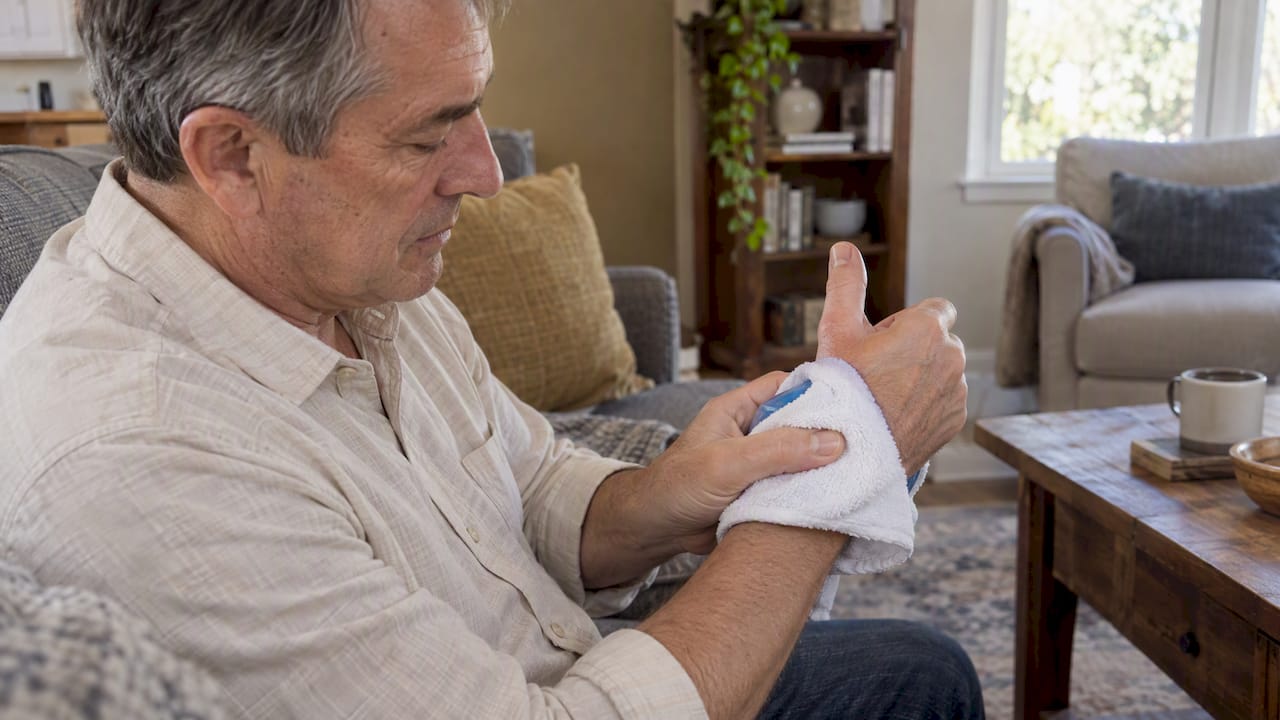
The same Alberta guidance gives specific timing: ice for 10 to 20 minutes at a time, or heat for 20 to 30 minutes, two or three times a day (MyHealth Alberta). Put a cloth between the ice pack and your skin. Many people find ice better for a sore, swollen, recently aggravated wrist, and heat better for stiffness. Choose whichever eases your symptoms.
Over-the-counter pain medicine may help, but ask your doctor or pharmacist which one suits you, especially if you take other medications, are pregnant or are breastfeeding. We do not give dosing advice here because the right choice depends on your health history.
A splint holds the thumb and wrist in a resting position so the tendons are not dragged through the tunnel with every movement. It is most useful when symptoms are recent and mild, and it is often worn during the activities that provoke pain and sometimes overnight.
The Alberta guidance says to follow your doctor’s directions for wearing a splint (MyHealth Alberta), and we agree that individual direction matters. How long you wear it depends on how irritated the tendons are and what your job or sport demands. A few practical points we raise with patients:
A 2024 review comparing treatments, published in an academic journal, found that corticosteroid injections are often more effective than immobilization alone, and that combining the two may add benefit. That does not make splinting pointless. It means splinting is a starting point, and if it is not helping after a reasonable trial, the plan should change rather than continue unchanged.
People searching for thumb tendonitis exercises often want to start stretching right away. The timing matters. Alberta’s care guidance says your doctor may suggest gentle stretching exercises once your symptoms are gone (MyHealth Alberta). Stretching a tendon that is still inflamed can provoke it again and set you back.
A sensible progression looks like this:
We do not publish a single list of exercises with set repetitions, because the right movements, and how hard to push them, depend on what your wrist does under load. Someone recovering from a baby-lifting flare-up needs a different plan from a climber returning to the wall. If you have also had hand tingling at night, our carpal tunnel exercises guide covers a related set of problems that sometimes coexists with thumb-side wrist pain.
If home care has not been enough after a couple of weeks, or if the pain keeps coming back as soon as you return to your usual tasks, supervised rehabilitation is the next reasonable step. Treating only the tender spot often misses the reason it became irritated. A thorough assessment looks at the thumb, wrist, forearm muscles, elbow, shoulder and neck, as well as how you grip, type, lift or play.
At Shephard Health in Calgary, our approach is built on a biomechanical assessment and an individualized plan. Depending on what we find, your plan may draw on several of the techniques we offer, and we explain what each one does so you can make an informed choice:
We do not promise a particular result or timeline. Tendons heal at their own pace, and the quickest route is usually a plan that combines relief now with changes to what caused the problem. Our guide to soft tissue damage recovery timelines explains why recovery is staged rather than instant.
Some cases do not settle with rest, splinting and rehabilitation. Then your doctor may discuss a corticosteroid injection into the tendon sheath. The review above suggests injections are often more effective than immobilization alone (academic review, 2024). This is a medical procedure, so it is arranged through your physician or a hand specialist, and you should ask about risks and what to expect afterward.
If an injection does not work, surgical release of the first dorsal compartment, the tunnel the tendons run through, can relieve the pressure on them, as Medscape’s treatment overview explains. Recovery usually involves about a week in a soft dressing, followed by early movement for light activities, according to the same source. One clinical article reports a cure rate above 90% for surgery, although individual outcomes vary and surgery has its own risks.
Most people will not get here. But knowing the path removes some of the worry. If you are being referred, your rehabilitation can continue after the procedure, with movement and strength work guided by your surgeon’s instructions.
Persistent thumb pain deserves a second look rather than more waiting. Alberta’s guidance says to contact your doctor or nurse advice line if you do not get better as expected, and to seek help for new or worse pain, numbness or tingling, or a weaker hand (MyHealth Alberta). In Alberta, Health Link (811) is the nurse advice line.
If progress has stalled, these are the questions worth asking:
If you have numbness, tingling, a visibly swollen or red hand with fever, or sudden loss of strength, see a physician quickly instead of trying another week of home care.
We see thumb-side wrist pain regularly in active people and in families, and the pattern is consistent: people wait because the pain seems minor, then it limits something they care about. Our view is that the earlier you change what the tendons are asked to do, the more options you keep.
We also think the wrist is rarely the whole story. Grip strength, forearm tightness, posture at a desk, and how a baby or a barbell is held all feed into the load on the thumb tendons. That is why we begin with a full assessment rather than a standard protocol, and why we explain each technique before we use it. Our goal is to relieve the pain, restore your function and help you avoid the next flare-up, while being honest when you need a physician’s input.
— Deane
If your thumb or wrist pain is interfering with work, sport or looking after your family, we can assess it and build a plan around your goals. We offer same-day appointments and direct insurance billing where applicable, which can make it easier to start without delay.

You can see everything we offer on our services page, read about what to expect at a first chiropractic visit, or start from the Shephard Health home page to book.
It varies with how long you have had it, how irritated the tendons are and whether you can avoid the aggravating movements. Mild, recent cases often improve with conservative care, while long-standing ones can need more. If you are not improving as expected, contact your doctor, as MyHealth Alberta advises.
Yes, for many people home care is the first step. Stop or change the activities that cause pain, rest the hand and wrist, follow directions for a splint, and use ice or heat. If symptoms are getting worse or you have numbness or weakness, get assessed.
Not during a flare-up. Gentle stretching is generally introduced after the symptoms have gone, and a clinician can guide which movements suit you and how to progress them. Pushing into sharp pain can irritate the tendons again.
Surgery is usually considered when rest, splinting, rehabilitation and injections have not worked. It releases the tunnel the tendons run through. Your physician or a hand surgeon decides this with you, based on your symptoms and goals.
Same Day Appointments Available
We Direct Bill!