

Golfer’s elbow (medial epicondylitis) is pain on the inside of the elbow, where the forearm muscles that bend your wrist attach to the bone. The best-supported treatment is conservative: change the aggravating activity, then rebuild the tendon with progressive strengthening. Up to 85 to 95% of patients respond to initial non-surgical care. Despite the name, you don’t need to play golf to get it. Racquet sports, climbing, throwing, lifting and desk or trade work can all load the same tendon.
This guide walks you through the steps in order: confirming it really is golfer’s elbow, settling the pain, rebuilding strength, deciding whether extra therapies make sense, and knowing when to be seen.
Treatment only works when the diagnosis is right. Golfer’s elbow typically causes tenderness just below the bony bump on the inner elbow, and pain when you grip, lift, shake hands or turn a doorknob. Clinicians look for pain on resisted wrist flexion and pronation (turning the palm down). A review of the diagnostic evidence stresses that symptoms outside this pattern, or any radiating numbness, call for an evaluation to rule out other causes such as cervical radiculopathy, ulnar nerve entrapment or ligament instability. Those conditions are managed very differently.
Imaging is rarely the first step. Plain X-rays are usually normal with tendon problems, as the primary care guide to elbow pain notes. Ultrasound can help when the picture is unclear: one review reports a sensitivity of 95% and a specificity of 92% for ultrasound in confirming the condition. In most cases a hands-on examination by an experienced clinician is what guides care.
The ulnar nerve runs in the groove right beside the painful spot. Practitioners report that up to 60% of patients with golfer’s elbow have some ulnar nerve involvement. If you feel tingling, burning or numbness into the ring and little finger, or your grip feels clumsy, mention it early. Nerve involvement changes the plan, and it is one of the main reasons to be assessed rather than self-treat indefinitely.
Tennis elbow affects the outer side of the elbow and the wrist extensors. The two conditions are treated in a similar way, and the research on golfer’s elbow is thinner than for its lateral counterpart. If your pain is on the outside, our tennis elbow recovery guide is the better fit.
The first weeks are about reducing the load on the tendon, not switching your arm off. Government clinical guidance lists avoiding aggravating activities and, where needed, using a constrictive band as first-line, non-drug measures. In practice, the useful question is which movement is the problem.
Try this for a week:
Guidance for this condition suggests modifying the repetitive motion for at least 6 weeks to give the tendon time to heal. Complete rest is less effective than retraining the movement pattern, because a deconditioned tendon is a weaker tendon when you return.
Ice for short periods after activity can ease soreness, and some people prefer heat before gentle movement. These are comfort measures, not cures. Oral or topical anti-inflammatory medicines are among the options listed in the clinical overview of treatment. If you have stomach, kidney, heart or blood pressure concerns, or take blood thinners, check with a pharmacist or physician before using them.
This is the step that decides whether the problem resolves or returns. Physical therapy focused on progressive strengthening and flexibility is considered the most proven long-term strategy, and the guidance describes a staged progression: gentle passive movement, then active-assisted movement, then isometrics, and finally full eccentric strengthening, where the muscle is loaded while it lengthens.
Here is what that can look like. Your own program should be set by your assessment, and the pain you feel during each exercise is the guide.
| Stage | Typical focus | Example | What to watch |
|---|---|---|---|
| Early | Calm irritation, keep range | Gentle wrist and elbow range of motion | Mild, settling discomfort only |
| Isometric | Load without movement | Hold the wrist flexors against light resistance | Pain should not climb or linger overnight |
| Strengthening | Build capacity | Slow wrist flexion with a light weight, forearm rotation | Controlled tempo, steady progression |
| Eccentric and return to sport | Full load tolerance | Slow lowering phase, grip work, sport-specific drills | Grip strength matching the other side |
Published rehab programs for inner elbow pain commonly use 2 to 3 sets of 8 to 15 repetitions, three times a week as a starting framework, though you should confirm numbers with your clinician rather than copying a table from the internet.
This is the most common mistake we see described in the clinical literature. The clinical overview of medial epicondylitis points out that people often drop the exercises as soon as the pain subsides, which raises the risk of recurrence. The target is not zero pain. It is a tendon that can tolerate your real-life loads again, whether that is a full round of golf, a climbing session or a day of lifting.
The elbow is often the place where a bigger problem shows up. A good assessment looks at wrist mechanics, shoulder stability and posture, because treating the elbow in isolation often misses what caused the overload. Golfers might have a swing that dumps force into the forearm. Desk workers may have a poorly positioned keyboard. Lifters may have weak shoulder stabilizers pushing more work onto the forearm.
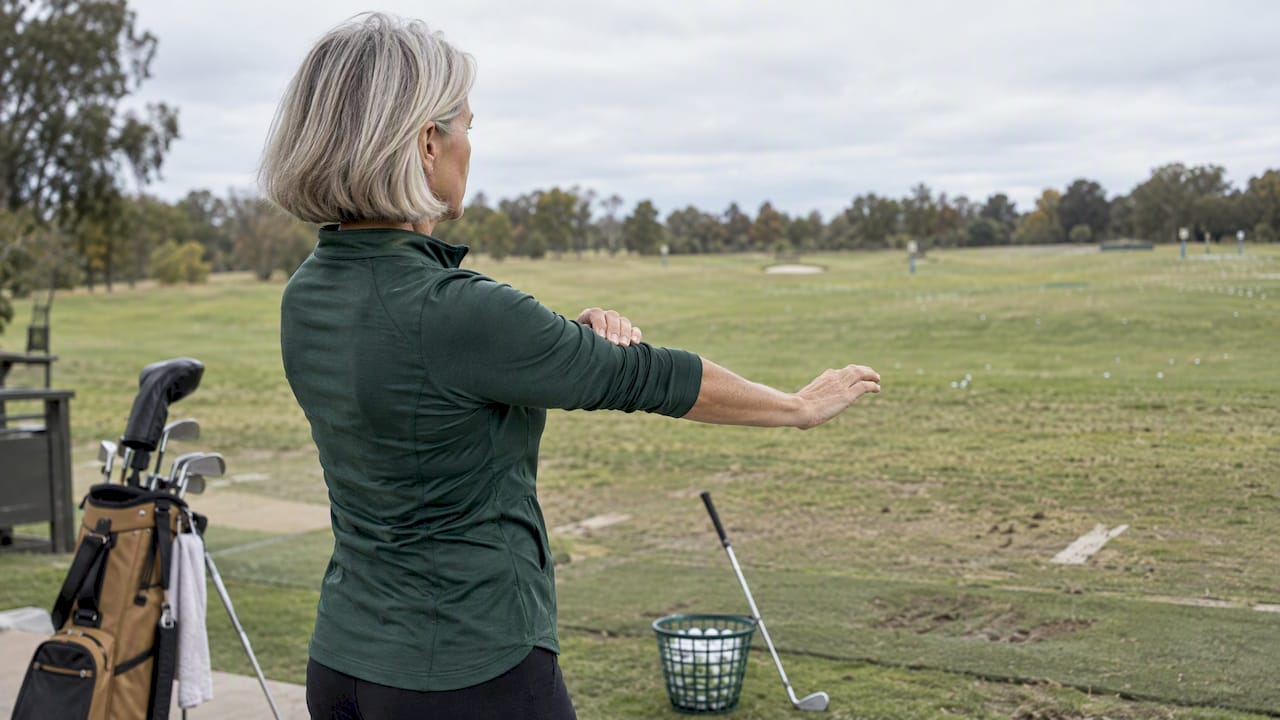
If you play golf, a structured warm-up helps your forearms and shoulders get ready before the first swing. This 10-minute pre-round golf warmup is one routine you can use alongside rehab. Whatever routine you pick, include wrist, forearm and shoulder movement and build up gradually.
Once the basics are in place, a clinician may add other tools. These work best as part of a plan, not in place of strengthening.
Soft tissue techniques aim to reduce tightness and restrictions in the forearm, and adjustments or mobilizations of the wrist, elbow, neck and upper back can address stiffness elsewhere in the chain. At Shephard Health we offer Active Release Technique (A.R.T.), Graston Technique and massage therapy, all of which can be used on the forearm flexors as part of a broader rehab plan.
For stubborn cases, shockwave therapy and laser therapy are commonly used. Be realistic about the evidence. Systematic reviews describe mixed results for shockwave, PRP and dry needling, and they are typically viewed as adjuncts to an exercise program. A recent case series on shockwave for medial epicondylitis notes that evidence for this specific condition is still limited, and a review of elbow tendinopathies points out that good randomized trials are lacking.
That honesty matters to us. We offer shockwave therapy and laser therapy because they can be useful in the right patient, usually when progress with exercise has plateaued, and always alongside a loading program. For how a session works, see our shockwave procedure page.
A counterforce strap or tape can reduce the force reaching the tendon during tasks you cannot avoid. Think of it as support during activity while the tendon is rebuilt. Kinesio taping is one option we provide.
Corticosteroid injections are often assumed to be the standard fix. They give fast short-term relief, usually under 8 weeks, but may weaken tendon tissue over the long term, and many clinicians now prefer to exhaust exercise-based rehab first. The same review notes that PRP injections tend to take longer to work but may last longer than steroids. Decisions about injections belong with your physician, and you should ask about the trade-offs.
Surgery is rarely needed. The American Academy of Orthopaedic Surgeons says most cases are treated successfully without it, and it is considered only after several months of appropriate non-surgical treatment have not helped. Research summaries put that window at roughly 6 to 12 months of failed conservative care.
Every tendon is different, but a rough picture helps you plan.
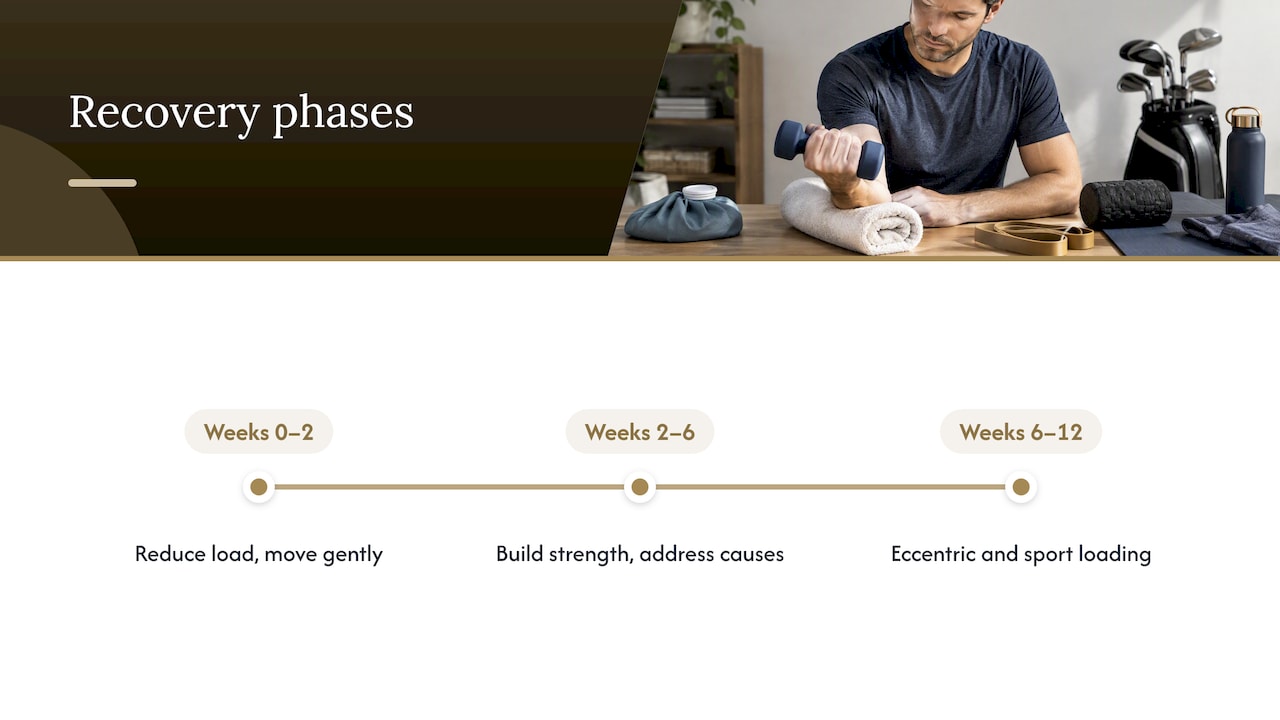
Weeks 0 to 2: identify triggers, reduce load, keep gentle movement, begin pain-tolerable isometrics if advised.
Weeks 2 to 6: progress to slow strengthening, address wrist, shoulder and posture contributors, adjust sport or work technique.
Weeks 6 to 12: build toward eccentric and sport-specific loading. Many therapeutic programs run 6 to 12 weeks or longer, and chronic cases can take months.
Flare-ups are normal. If pain rises after an exercise and stays up the next morning, scale back a step instead of stopping completely. Our overview of soft tissue recovery timelines explains how healing phases influence what is safe to load.
See a regulated health professional, such as a chiropractor, physiotherapist or physician, if:
The last three need prompt attention, and sudden severe symptoms after trauma should be seen urgently.
When someone comes to us with inner elbow pain, we don’t start with a machine. We start with a thorough biomechanical assessment of the elbow, wrist, shoulder and posture, and we confirm what is actually generating the pain, including whether the nerve is involved. From there we build a plan around your goals, whether that is a lower handicap, a return to the gym or simply carrying groceries without a wince.
We think the most common failure in elbow care is treating the symptom and ignoring the chain. We also think patients are served best when we are honest that tools like shockwave and laser are adjuncts: useful for stubborn tendons, but never a replacement for progressive loading. Our team works with active adults, athletes and families, and we aim for the same thing with each: restore function and reduce the chance of recurrence, not just quiet the pain for a month.
— Deane
If your elbow pain isn’t settling, our Calgary clinic can assess it, build an individualized rehab plan and combine hands-on care with therapies such as shockwave or laser when they suit your case. We offer same-day appointments and direct insurance billing where applicable. Learn more on our elbow pain treatment page, see how our physical rehabilitation works, or read what to expect on your first visit.
Start by identifying and reducing the movements that provoke the pain, rather than resting completely. Add gentle range of motion, then gradually progress to isometric and slow strengthening exercises as pain allows. If there is no improvement in a couple of weeks, or you have numbness or tingling in your fingers, get assessed.
Mild cases can settle with load changes over weeks to months, but the tendon often remains weak if you do not rehabilitate it. That is why symptoms come back when people return to full activity too fast. A progressive strengthening program is the best-supported way to reduce that risk.
Golfer’s elbow is a common cause, especially if the pain is tender to touch and worsens with gripping or wrist flexion. Ulnar nerve irritation, ligament problems, arthritis and neck-related issues can also cause inner elbow pain. A hands-on assessment is the way to tell them apart.
It can reduce pain quickly, but the relief is usually short, under about 8 weeks, and there are concerns about tendon weakening over time. Many clinicians try exercise-based rehab first. Talk to your physician about the benefits and risks for your situation.
Many people notice improvement within weeks, but a full program usually runs 6 to 12 weeks, and stubborn cases can take longer. Continuing strengthening after the pain fades is what protects against recurrence.
Same Day Appointments Available
We Direct Bill!