

Non-surgical spinal decompression is designed to ease pressure on irritated discs and spinal nerves, and the benefits people most often report are less back, neck or leg pain, easier movement and better day-to-day function. Studies on these outcomes are encouraging, and they are still growing. Results depend on what is causing your pain, how the treatment is delivered and what you do alongside it. This guide explains the potential benefits, what the evidence says for the lower back, the neck and herniated discs, and how to decide whether it fits your situation.
Spinal decompression therapy is a computer-controlled form of traction. You lie on a table, usually fitted with a harness, and the device applies a gradual stretch to the spine, then releases it, in cycles. The idea is to create a small amount of space between vertebrae, lower the pressure inside the disc and take load off the nerve roots that run beside it.
Researchers describe the newer approach as a computerized mechanism that expands the space around spinal nerve roots through segmental distraction, which is what separates it from older, simpler traction. The proposed benefits follow from that: less pressure on a compressed nerve, a chance for bulging disc material to settle back, and better fluid and nutrient exchange in the disc.
It also helps to know what decompression is not. Spinal decompression surgery, such as a laminectomy or discectomy, removes bone or disc material to free a nerve. Non-surgical decompression involves no incision, no anesthesia and no removal of tissue. It is a conservative option, typically considered before more invasive steps are discussed with a physician.
When patients ask about spinal decompression benefits, the same handful of outcomes come up. Here is what each one means in practice, and how well the research supports it.
Pain relief is the main goal. Because decompression aims to reduce pressure on a nerve root, the pain it targets is often the sharp, radiating kind: pain that travels from the low back into the buttock or leg, or from the neck into the shoulder and arm. Most of the published trials measure this on a standard pain scale, and most report improvement in the groups that received decompression.
Pain that limits how far you can bend or turn tends to limit work, training and family life too. In research, function is usually tracked with disability questionnaires and range-of-motion measurements. Improvement in those scores is among the more consistent findings, which matters more to many active people than a pain number alone.
Lower pressure inside the disc is thought to support nutrient exchange and the body’s own recovery process. Some small studies have measured changes on imaging. A 2025 case series of 13 patients who received 20 sessions reported significant improvement in pain, disability and self-rated recovery, with average disc height increasing by 1.0 to 1.6 mm. A series that small cannot prove cause and effect, but it shows the kind of change researchers are looking at.
For many people the practical benefit is simply having a gentle option to try. There is no recovery period, sessions are typically about half an hour, and most people go straight back to normal daily activity. If you want to see how this fits a Calgary treatment plan, our spinal decompression service page explains how we use it.
The research base is a mix of small randomized trials, comparison studies and clinic-based series. Read together, the picture is hopeful but still developing.
The strongest recent result is a 2022 randomized controlled trial of 60 patients with lumbar radiculopathy. The group that received non-surgical decompression plus routine physical therapy did better than the group that received physical therapy alone after four weeks. Pain, range of motion, functional disability, back muscle endurance and some quality-of-life measures all favored the combined approach, with medium to large effect sizes.
The design of that trial is worth noticing. Decompression was added to active care rather than used on its own. That mirrors how we think about it clinically, and we come back to it in our perspective below.
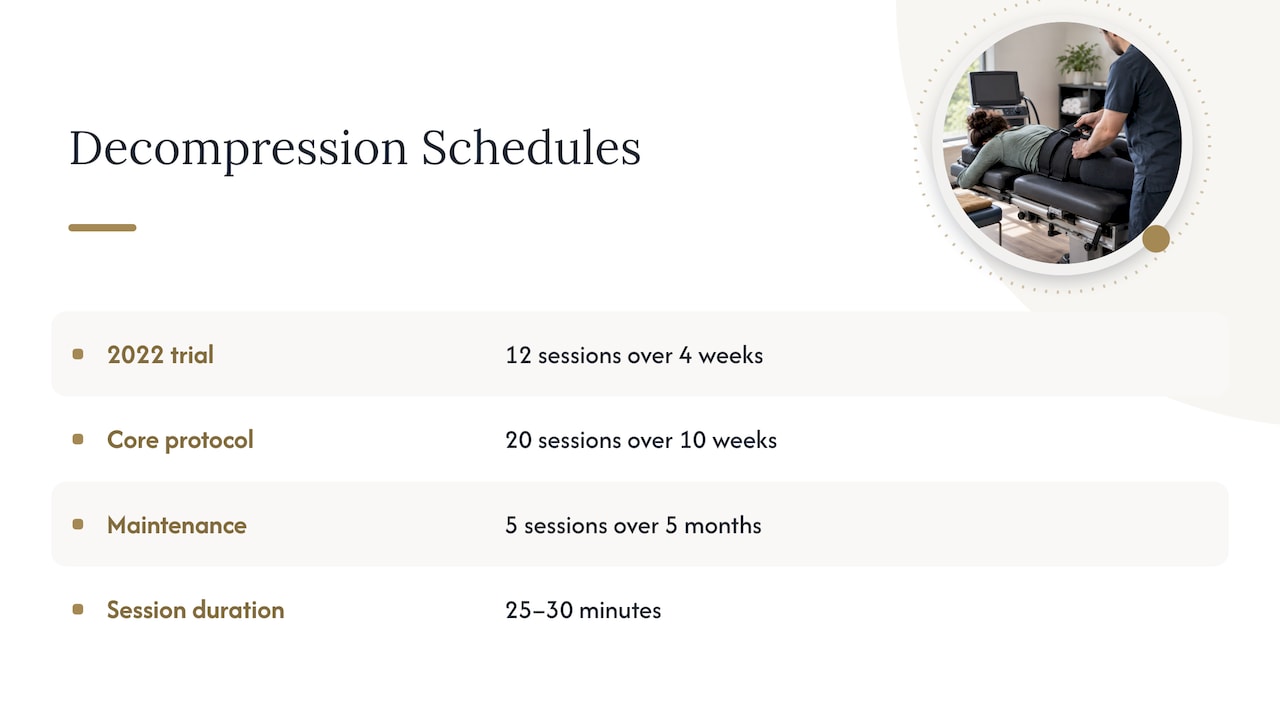
A review of IDD therapy published in 2024 notes that multiple published studies show positive effects and also that more long-term studies with large samples and long follow-up are needed before it can be called a standard of care for low back pain. It also describes a protocol many clinicians follow: about 25 sessions of 25 to 30 minutes, made up of 20 sessions over 10 weeks and 5 maintenance sessions over 5 months. Your own schedule will vary with your assessment.
Older reviews reached more cautious conclusions because the studies available then were few and small. A 2007 review in the Journal of Chiropractic Medicine and a 2006 systematic review both called for better trials. Newer randomized work, like the 2022 study above, has begun to answer that call.
A herniated disc is one of the most common reasons people look into this therapy. When disc material presses on a nearby nerve, the result can be leg pain, numbness or tingling, sometimes more noticeable than the back pain itself.
The disc-related research points in a consistent direction. In the 2022 trial above, the people with lumbar radiculopathy improved across several measures after 12 sessions over four weeks. A 2018 randomized trial from Turkey in patients with lumbar disc herniation found that both conventional motorized traction and non-surgical spinal decompression helped with pain and functional status. In that study, decompression was not shown to be better than conventional traction, which tells you that the principle of controlled spinal unloading seems to matter, and that more research on the differences between devices is still needed.
A practice-based report from a clinic network analyzed 168 lumbar cases treated over six to eight weeks. The average pain reduction was 4.3 points after about 15 visits, and no serious adverse effects were reported. Because it came from clinical practice without a control group, it supports the case for a closer look rather than settling the question.
If your main symptom is leg pain, our article on spinal decompression for sciatica explains why we pair it with active rehab, and our guide to lumbar radiculopathy treatment covers the other options we consider. For narrowing of the spinal canal, see spinal decompression for stenosis.
Neck decompression follows the same principle with a different setup: the stretch is applied to the cervical spine, usually with the patient lying face up and a comfortable head and chin support. The goal is to ease pressure on discs and nerve roots that can send pain, tingling or weakness into the shoulder, arm or hand.
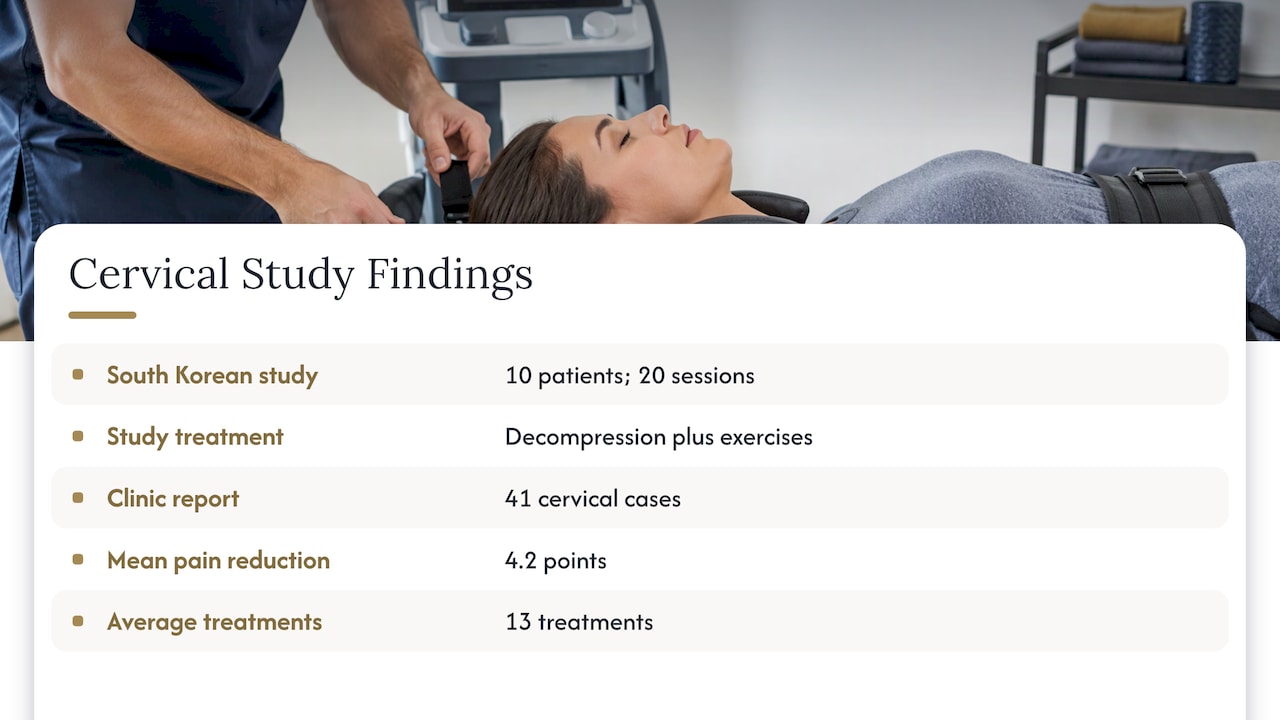
Evidence for the neck is smaller than for the low back, but it exists. A South Korean study of 10 patients with cervical radiculopathy found significant improvement in pain and in the Neck Disability Index after 20 sessions of decompression combined with mobilization and stabilization exercises. The authors noted the small sample and the absence of a control group.
The clinic-based report mentioned earlier also included 41 cervical cases, with mean pain reduction of 4.2 points after an average of 13 treatments and no serious adverse effects reported.
Two things stand out. First, in the neck study decompression was part of a multimodal plan with mobilization and exercise. Second, results are measured over a course of treatment, not one visit. If you have neck pain with arm symptoms, an in-person assessment is the way to find out whether cervical decompression suits you.
A typical course runs over several weeks. The 2022 trial used 12 sessions in four weeks, while the longer protocols in the literature stretch to 20 sessions over 10 weeks with maintenance visits afterward. Within a session, you lie fully clothed on the table, are comfortably secured, and the device cycles through stretch and rest phases for roughly 25 to 30 minutes. Most people describe it as a gentle pull, not a painful one.
To judge whether it is helping, track a few things from your first visit: your pain score on a 0 to 10 scale, how long you can sit, walk or train before symptoms start, and which movements are still limited. Improvement often shows as a gradual shift, such as leg symptoms retreating toward the back or lasting less time, rather than a sudden change. Share these notes with your clinician at each review so the plan can be adjusted.
If you want to know what follow-up looks like once sessions begin, our page on spinal decompression aftercare walks through it.
Canada’s own PEER primary care research gives useful context here. Its systematic review for chronic low back pain found that exercise was the only intervention with sustained benefit, and that spinal manipulation also showed consistent evidence of efficacy. The PEER guideline likewise lists spinal manipulation among the options worth discussing for chronic low back pain.
That is why we see decompression as a way to create room to move, which you then use. When pressure on an irritated nerve drops, exercises, mobility work and strengthening often become easier and more comfortable to do. The 2022 trial’s result, that decompression plus physical therapy outperformed therapy alone, fits that approach.
Other non-surgical approaches are also being studied for how they support the body, and you can read an evidence overview of compression therapy to see how researchers weigh benefits against the strength of the studies in a related area.
Spinal decompression is generally considered for people with disc-related back or neck pain, radiating nerve symptoms, or pain that has not eased with initial care. It is not a fit for everyone, which is why the first step is an assessment. We look at your history, your movement, your neurological signs and any imaging you already have before suggesting it.
Some situations call for medical attention before any hands-on or device-based treatment: pain after a significant fall or accident, new weakness in a leg or arm, numbness in the groin or saddle area, loss of bladder or bowel control, unexplained fever or weight loss, or pain that is severe and worsening. If you notice any of these, see a physician or go to an emergency department. Mention pregnancy, osteoporosis, previous spinal surgery or implants at your assessment too, because they affect which treatments are appropriate.
Canadian regulators set expectations for how clinics talk about this therapy. The College of Chiropractors of Ontario states that decompression is a form of traction used by several regulated professions and that fees must be clinically necessary, fair and fully disclosed in advance. A good clinic will give you the same clarity wherever it is located: what is proposed, why, for how many sessions and at what cost. Our page on spinal decompression cost in Calgary explains how a written course estimate works, and our overview of spinal decompression risks covers safe use in more depth.
We use spinal decompression because we see it as a practical way to take pressure off a painful spine so that rehabilitation can do its job. We do not offer it as a stand-alone answer.
At Shephard Health, we begin with a comprehensive biomechanical assessment. That tells us whether your pain pattern points to a disc, a nerve, a joint or soft tissue, and which of our tools fits. Decompression may be one piece, alongside chiropractic care, Active Release Technique, laser therapy, shockwave therapy and a progressive exercise plan built around your goals.
Our team treats athletes, active adults and families, and the goal is the same for all of them: less pain, restored function and fewer repeat flare-ups. We keep the plan individual, we explain every step in plain language, and we review your progress at regular intervals so you always know where you stand.
The research supports this combined approach, and we will tell you honestly what is known and what is still being studied. Our same-day appointments and direct billing to insurance, where applicable, are there to make starting care easier.
Deane
If you are living with disc-related back pain, leg symptoms or a stiff, painful neck, the simplest next step is an assessment. We will review your history, examine how you move, explain whether spinal decompression is likely to help, and outline a plan with the number of sessions in writing. We offer same-day appointments and direct insurance billing where applicable.

You can learn more about spinal decompression at Shephard Health, or reach us through our main site to book a visit.
That varies by person and condition. Studies typically measure results after a course of sessions, such as 12 sessions over four weeks in one randomized trial. Many clinicians track changes in pain, sitting tolerance and movement from the first visit so the plan can be adjusted as you go.
Research on lumbar disc herniation and radiculopathy suggests it can reduce pain and improve function, especially when combined with physical therapy. The 2022 randomized trial found better outcomes with the combination than with physical therapy alone. An assessment will show whether your symptoms fit.
The principle is the same, but the positioning and settings are different because the cervical spine is smaller and more delicate. Studies on the neck are fewer and smaller, and they usually combine decompression with exercise and mobilization. Your clinician will adapt the approach to your symptoms.
No. Decompression surgery removes bone or disc material to free a nerve. Non-surgical decompression applies a controlled stretch to the spine while you lie on a table, with no incision and no anesthesia. Many people return to normal activity right after a session.
We begin with an in-person assessment and use any imaging you already have as part of it. Your physician will advise on imaging if your symptoms or history call for it. Contact us to confirm what to bring to your first visit.
Same Day Appointments Available
We Direct Bill!