

Kinesio tape (often sold as KT tape) can ease knee-cap pain for some people, but it does not reliably fix how the patella tracks. The evidence suggests it works as a short-term comfort aid alongside exercise, not as a correction. Below, we explain what patellar tracking problems are, what the research says, how a published knee-cap taping technique is applied, when to leave the tape off, and how taping fits into a rehab plan.
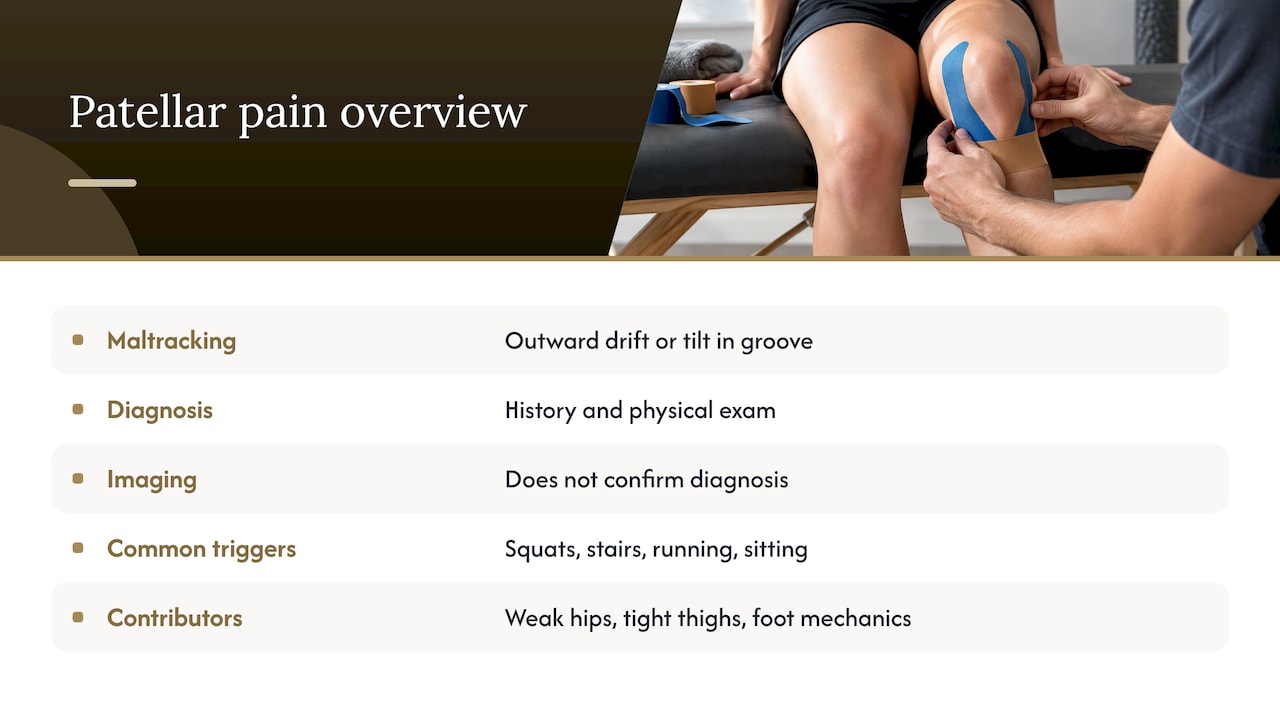
Your patella (knee cap) sits in a groove at the end of the thigh bone and glides up and down as you bend and straighten the knee. “Patellar maltracking” describes the idea that it doesn’t glide centered in that groove, often drifting or tilting outward. The result is usually a dull ache at the front of the knee that flares with squatting, stairs, running or long periods of sitting.
The clinical label is usually patellofemoral pain syndrome. It is a clinical diagnosis, made from your history and a physical exam that includes functional tests, rather than something an image confirms. Canadian federal primary-care guidance lists it among the causes of knee pain and says an assessment should look at alignment, swelling, tenderness, range of motion, quadriceps and hamstring strength, gait and neurovascular status.
That list matters for you. Tracking is only one piece. Weak hips, tight thigh muscles, foot mechanics, training load and sudden changes in activity can all contribute, so taping the knee alone treats a single symptom of what is often a larger pattern.
People searching for taping for patellar maltracking are often mixing up two quite different products.
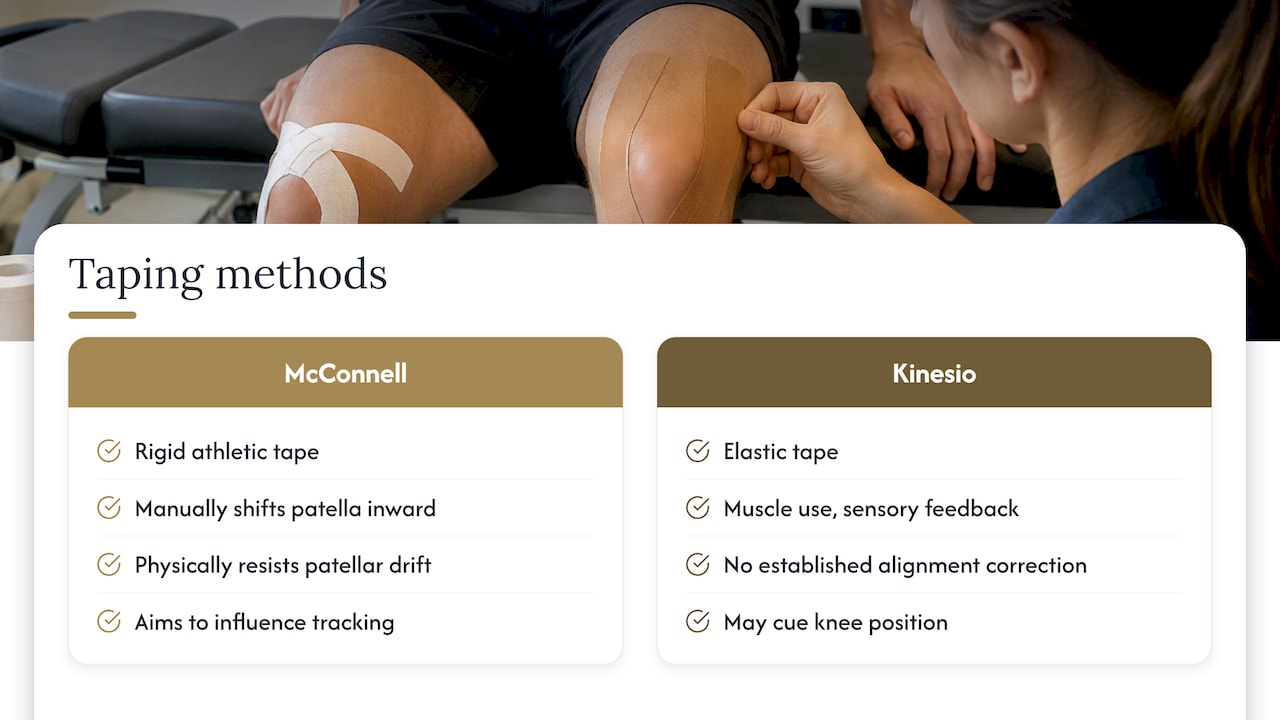
McConnell taping uses rigid athletic tape. The clinician manually moves the patella toward the inside of the knee and holds it there, so the tape physically resists the drift. The 2015 systematic review comparing the two methods describes it as aimed at influencing alignment and tracking.
Kinesio tape is elastic. It is designed to be used on muscles and to give sensory feedback, and the same review states it does not have established patellar-alignment correction. In practice, that means a stretchy strip around the knee cap may remind you where your knee is and feel supportive, but it is unlikely to hold the patella in a new position while you move.
If your clinician believes a mechanical shift is what you need, they may choose rigid tape. If your goal is comfort, muscle activation cues and being able to train, kinesio tape may be reasonable. Our broader piece on what the evidence shows about kinesiology tape covers other body areas as well.
The honest answer is mixed, and it helps to see both sides.
A 2025 systematic review and meta-analysis in BMC Musculoskeletal Disorders pooled 10 randomized trials published between 2011 and 2022, with 364 patients: 184 received kinesiology tape and 180 were controls. Tape reduced pain and raised Kujala scores (a questionnaire that measures knee-cap pain and function) compared with controls.
The same analysis found no significant differences in knee strength, flexion range of motion or joint-position error. And the authors noted the included studies were relatively low quality. So the pain and function signal is real in the data, but it is not strong.
Cochrane’s 2022 review of taping across the knee cap included five small, varied randomized trials with roughly 200 adults with patellofemoral pain. All involved co-interventions, usually exercise, and were judged at high risk of performance bias. At the end of treatment, taping did not produce a statistically or clinically significant pain difference versus no tape or placebo tape: a mean difference of -0.15 on a 0 to 10 scale (95% CI -1.15 to 0.85), from four trials and 161 knees.
One trial paper on adding tape to exercise therapy also acknowledged that its authors did not confirm whether tape could reduce abnormal patellar tracking during muscle performance tests. In other words, the tracking claim in the search query is the least supported part of the story.
Tape may take the edge off pain for some people, partly through sensory feedback and expectation, and that can be useful if it lets you do your exercises with less discomfort. It should not be sold to you as a way to realign your knee cap. If a product or video promises that, be skeptical.
This is for understanding, not a protocol to copy at home. The techniques below come from published sources and were applied by trained clinicians. The 2015 review notes that these are study techniques, not a universal self-treatment protocol.
A 2024 paper on biomechanical taping and kinesiotaping describes the following approach for knee-cap support:
The 2015 review describes another kinesio approach, a medial-shift application at roughly 50 to 75% tension, while Y-shaped muscle applications (for instance over the quadriceps) were described at about 10 to 15% tension. The gap between those numbers tells you something: tension is a clinical decision. Too little does nothing, too much irritates skin and can make the knee feel worse.
A 2020 guideline on applying kinesiology tape says skin should be clean and free of oil, dirt and sweat. Lotions and sweat both reduce adhesion, and a poorly adhered strip tends to peel at the edges and tug on the skin.
Clinicians commonly leave kinesio tape on for a few days, but the right duration depends on your skin, activity and the tape brand. Follow the instructions from the person who applied it, and take it off sooner if the skin objects.
Some situations call for assessment before any taping.
Get the knee looked at if the diagnosis is uncertain, the pain followed a significant trauma or high-speed event, or the knee is swollen, unstable, locking, giving way or unable to bear weight. The same applies if motion is substantially restricted. Canadian primary-care guidance also flags factors from the Ottawa Knee Rule that prompt consideration of an X-ray after an acute injury: tenderness over the patella or the head of the fibula, being unable to flex the knee to 90 degrees, being unable to take four steps, and being 55 or older.
In practical terms: if you twisted your knee, felt a pop, and now it looks puffy, tape is not the next step. A hands-on exam is, and a physician can decide whether imaging is needed. If the pain is more of a slow, aching, activity-related problem, a chiropractor or other rehab clinician can assess it and decide whether tape is worth trying.
Remove the tape immediately if you notice itching, skin irritation or any other undesirable effect, and do not reapply, according to the 2020 application guideline. If you have sensitive skin, tell the clinician before they apply anything.
The tape manufacturer’s general guidance is to remove elastic tape while it is wet, keep the skin taut and peel in the direction of hair growth. The same page says the diagnosis and treatment goals should be set by a physician or physiotherapist. Our own guide to peeling tape without hurting your skin walks through the steps, and it also covers what to do if you have sensitive skin or an allergic reaction.
The consensus on patellofemoral pain is consistent. A review of athlete management summarizing the 2018 international consensus statement reaffirms exercise as first-line treatment, with an emphasis on hip and knee exercises. It describes taping, bracing and foot orthoses as extra options that can be considered, and notes that treatment is largely conservative, built on activity modification and physical therapy.
That gives taping a clear job: a short-term helper. A sensible sequence looks like this.
A proper assessment checks how the knee moves, how the hips and ankles are working, how strong the thigh muscles are and how you load the knee in your sport or job. This is where a cause is identified rather than guessed.
Adjusting volume rather than stopping entirely often works best. Tape, soft tissue work or other in-clinic therapies can make this phase more comfortable. Our article on soft tissue recovery timelines explains how we think about loading during healing.
Hip and thigh strengthening, movement pattern work and a gradual return to sport do the long-term job. Tape can be used during this stage to give feedback while you practice, and then it is faded out as the muscles take over.
If foot mechanics seem to be involved, an orthotic discussion may belong in the plan. If tissue around the knee is stiff, hands-on techniques may help. The point is that tape never has to carry the whole plan.
We see knee-cap pain in runners, hockey and soccer players, desk workers and teenagers in growth spurts. The pattern we notice most often is that people reach for tape because it is quick and cheap, and then wonder why the pain returns when it comes off. The tape was never addressing the reason the knee was irritated.
We use kinesio tape as one tool within an individualized, evidence-based plan that starts with a biomechanical assessment. For some patients it gives enough comfort and feedback to make exercises easier. For others it adds nothing, and we say so rather than keep applying it. We would rather you leave with a plan you can follow than a strip you need to replace every week.
We also think expectations should be honest. The research does not support the claim that elastic tape realigns the patella, and we do not make it. What we can do is figure out what is driving your pain, build the strength and control to manage it, and use tape where it helps. Our fuller Alberta guide to kinesio taping for knee pain goes deeper on how we use it.
— Deane
If your knee cap pain has lasted more than a couple of weeks, keeps coming back or limits your training, an assessment is a better first step than another roll of tape. At Shephard Health we offer same-day appointments, direct insurance billing where applicable, and a range of non-invasive options alongside kinesio taping, including chiropractic care, physical rehabilitation and shockwave therapy for knee pain. You can see everything we offer on our services page, or book through our home page.
If you are unsure what to expect, our guide to your first chiropractic visit explains the process from intake to treatment plan.
No, not in the sense of moving the patella and holding it there. Rigid McConnell taping was designed to do that, while a 2015 review states kinesio tape does not have established alignment-correcting effects. Kinesio tape may still reduce pain for some people, which is a different outcome.
It depends on the technique and who applies it. Published examples use around 50% tension or more for strips near the patella and much lower tension, about 10 to 15%, for muscle strips. Because tension is tied to your anatomy and skin, we suggest having a clinician show you rather than guessing at home.
Some people do, but results vary and skin problems are more likely with poor preparation or too much stretch. If you want to try, start with clean, dry, oil-free skin and remove the tape right away if you feel itching or irritation. Have your knee assessed first if it is swollen, locking or giving way.
No. International consensus keeps exercise, particularly for the hips and knees, as first-line care, and Cochrane found no clear pain advantage of taping over no tape or placebo tape at the end of treatment. Think of tape as something that may make exercise easier, not something that replaces it.
Same Day Appointments Available
We Direct Bill!